Journal Home
THE
WORKERS
OF
UTAH.
BY
GEORGE W.
BRIMHALL
PROVO CITY, UTAH.
PRINTED BY THE ENQUIRER COMPANY
PREFACE
My apology for presenting this work to the public is to encourage the toiler, and to point the weak to the true source of moral strength. If it should accomplish this, then the one great aim of the work shall have been secured. That there has been throughout my somewhat peculiar life a divine providence overruling for the benefit of myself and others, is to me, at least, and I trust may appear to the reader, quite evident and clear. I, therefore, send forth these pages in the sincere hope and earnest prayer, that they may lead some to a life of righteousness, and to an implicit trust in His providences, whose ways are perfect, whose course is unerring, and whose reward is sure. Asking for that charity which I would be willing to extend to others under similar circumstances, the work is respectfully submitted by the author.
- GEORGE W. BRIMHALL.
________________
COPYRIGHT SECURED.
1st Edition 1889
2nd Edition 1950
3rd Edition 1951
Reprinted at Provo, Utah, for members of the
George W. Brimhall Family.
4th Edition 1996
Computerized Edition - Provo, Utah
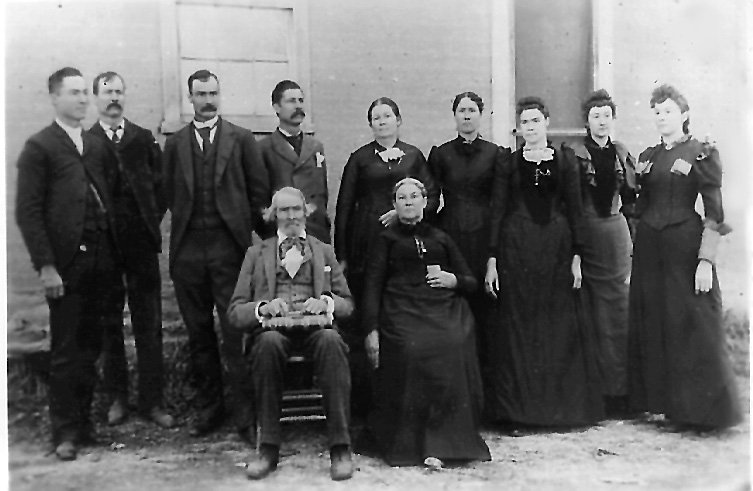
The First Family of George Washington Brimhall and Rachel Ann Meyers
1892
(Left to right - back row) Ether, Omner, Emer, George H., Rachel, Arilla, Ruth, Tryphena, and Grace
(Seated in front) George Washington Brimhall and Rachel Ann Meyers Brimhall
Note: Two other daughters died early in life -- Purdence and ? (Source - Golden H. Brimhall, 1996)
CONTENTS
CHAPTER I.-- Early Life. Influence of a Prayerful Mother. Makes Acquaintances of General Harrison. The Wonderful Find.
CHAPTER II.-- Begins with Experience. Mouth of Emigration Canyon, Utah. Whites Settling in that Canyon. Breakfast on Antelope. Build a Fanning and Grist Mill. Selection of Brigham Young, Heber C. Kimball and Willard Richards as Committee to Aid the Colony.
CHAPTER III.-- Committee of Safety Organized Consisting of Twelve Men. George A. Smith in Charge of a Company Bound for Iron County. Journey in a Severe Winter Without a Sign of Civilization. Sudden Scare While on Guard. Ox Killed by Indians. Towns and Villages Grow up Like Mushrooms.
CHAPTER IV.-- Learns the Indian Language. Build a Fort. Devil Walker an Indian. His Dreaful Reign. Indian Children Purchased by Mrs. Decker and J. P. Barnard. Act Creating the Territory of Utah. Sent to House of Representatives. Doffs His Buckskin Suit. Abatement of Polygamy. Hardship to Families. Peopling of the Earth. Legislature of Utah. Married by Brigham Young.
CHAPTER V.-- United States Army en route to Utah. New Governor. Setting Fire to U.S. Trains. Northern Utah People Move South. Order in Traveling. Famine Threatened. Catch Fish. Governor Cummings. Evils of Army Influence. General Connor Fights the Indians. Evils of Ancient Rulers. King Davids's Failures. Dreadful Winter. Immense Loss of Stock. Guard Against Indian Invasion.
CHAPTER VI.-- Wonderful Hieroglyphics and Paintings. Laying Out Water Ditches. Strange Phenomena in the Rising Sun. Sent to Explore. Sinks Through the Ice with Team. Sudden Embrace by an Indian.
CHAPTER VII.-- Diffulties in Crossing the Clara. Plague. Indians Burn Each Other's Dead Bodies. Loses a Child. Carry Wagon up Mountain by Hand. Meet Anson Call. Poison Water. Oxen Poisoned. Three of Call's Horses Die. Suffer for Water. Sends His Son George H. after It.
CHAPTER VIII.-- Dead Scorpion. Climb Colorado Mountain Second Time. Heavy Floods. Arrive at St. George. People Discouraged. Dam Broken. Battle with Indians. Two Mormons Killed. A Number of Indians Fall in Battle.
CHAPTER IX.-- Great Treaty with Five Indian Nations. Brimhall Visits Salt Lake. Drouth as a Fulfillment of Prophecy. Visit to San Francisco. Improves from Bright's Disease. Returns to Utah. Independence Speech.
CHAPTER X.--Biography of Early Life. Killing a Panther. Shooting a Keg from a Man's Head. Immense Travel by Water.
A TRUE HISTORY.
CHAPTER I.
A long time ago I was a young man and I thought I would be honest, good and wise, should I live long enough. I thus determined to render myself useful to both self and others. With this motto for the rule of my life, I left home, remembering the good commandment of my father and honoring the admonitions of my mother, and without experience, to try to find a safe road through mortal life. And I have succeeded up to date. I was born November 14, 1814. In my youth I learned music from the thrush, goldfinch, crossbill and nightingale, with whose notes I was often delighted. I learned to read and compute numbers by torch light at the old kitchen fire. At twenty-one I began to work for others and to earn money, keeping good company and never going in the way of the transgressor. Believing in a Supreme Being, from overhearing my mother's secret prayers, I made him my friend. who has never deserted me. I have never been put on trial in any court of God or man, for my conduct, always working to establish peace. After fourteen years, securing a competency but not rich, I had traveled some taking in the Eastern states and making the acquaintance of General Harrison, of White Water, Ohio, General Pike, of Mamie, Indiana, and others, whose memories are sacred to me, not forgetting my parents. About that period I was a happy man.
Walking along one day, singing a favorite air, on the prairie, in my narrow flower-bound path, I saw something very brilliant at my feet, and stopped to examine the wonderful find. My eyes were now very good, I can yet see to read the finest print in common use. My heart and mind have never failed to complete a judgment of some kind. With great caution and care I raised it up, stepped back and looked all around, above, below. The far distant woodlands, with their green tops, the beautiful hillsides of the Spoon River, the expansive prairie with its then heavy crop of grass, herbage and flowers, containing food for the hart, roebuck and buffalo for centuries past, in turn supplying food and clothing for millions of accountable humanity. Casting my eyes again at the mysterious object at my feet, the question arose, who lost it here? Who owns it? Its head was of pure gold, its eyes, oh, such beauties, its nose perfection, its sweet gushing lips a complete charm, its arms and whole makeup, a perfect being. Casting my eyes toward the horizon again to catch an original thought, and to see if the coast was clear--all clear. Mysterious phenomena, did you come down from Heaven, or did the most brilliant metallic flowers hold a grand council for your make-up, or were you self existent and took you up your abode in this beautiful field of paradise as such? Stooping down upon one knee I gave it a closer look and ventured to speak to it. My breath came upon it. Who are you? said I, very softly, to whom do you belong? The figure began to move gently towards me and raising up its eyes, such lovely eyes, and opening its lips it answered and said, Nobody, I own myself. In its right hand were three diamonds. Its left was full of silver coins; the soles of her shoes were sea pearls. Perhaps she came from the bottom of the ocean. I could imagine, however, on first enquiry that it answered, "I came from yonder grove," and that morning as usual it had taken a walk in the path of the prairie, and enjoyed it so much had lain down, fallen into a trance, and I found it there, and concluding it belonged to itself, I thought of making arrangements to possess my vaulable find, so offered to assist it to the grove. It smiled consent, gently I raised it up and placed it in my affectionate bosom. No one objected to the proceedings, and of all I had ever possessed before this appeared. [Married Lucretia Metcalf, July 4, 1845.]
Five years passed away in prosperity, love and joy. The three diamonds had made their appearance; objects of great parental care. One sickened, passed out of sight, the others grew larger and brighter continually. One evening, returning home from my labors and business, I entered my door and saw my wife sitting on the other side of the room. She merely looked up. Not coming to me with a smile of embrace or kindly greeting. I turned to look out at the open door. The sun was shining in its strength upon a few evening clouds in the western horizon. All at once a dark shadow entered the house, who arose, lit a candle, and made arrangements for supper. I placed myself at the washstand, and afterwards at the glass. Reader, this is eternal truth, my hair was as white as the driven snow instead of the raven black as usual. My cheeks were sunken with wrinkles. My smooth, manly forehead covered with irregular furrowed frowns. Where am I now? thought I. What is the matter with me and my loved one? Had I not been a member of the temperance society I might have judged myself intoxicated, but I never break a good pledge. I thanked my Heavenly Father for the meal before me, asking His blessing upon it. Supper I did not relish, although served up in usual good style. My eyes rolled in every conceivable direction. My ears listened with extreme acuteness to catch some indication of the causes of this wonderful change. I resorted to every device my easier sagacity would suggest, and cunningly and artfully endeavored to ascertain what I had never before discovered, viz: the attributes and characteristics of my wonderful find. I tried to caress my oldest boy as usual, but a shy reticence was his reply. From our little girl lying asleep on the sofa in all its angelic innocence, I stole a tear-wetted kiss, and with my hand upon my breast (where I had always kept its mother) passed out of the house, which was situated in the border of a hickory and maple grove. By this time my cheeks were a flood of tears. "Hold on, my brave man," said a voice, "this will never do." I heeded the voice and received courage to meet my future.
Days past and no change; kind treatment was mutual. My affections for her continued, hers for me were cold and indifferent. My country seat lay about three-fourths of a mile east of Knoxville, a beautiful town in Illinois. In the month of February, 1850, the snow had settled upon the prairie and formed a crust, presenting one vast mirror, having the appearance of a sea of glass. My domestic animals are in good condition. Spring time will soon be here enlivening the world again, except me, a lone, disconsolate one. Under these conditions, in secret, I often appealed to my Benefactor for wisdom. At last He caused the future to pass before me. Standing in my door I saw myself in all my youthful manhood walking toward the west under such brilliant clouds as I had once seen before, while traveling through midlands, undulating plains, crossing rivulets, creeks and rivers, small and great, rising higher and higher to the table lands of great and lofty mountains, whose peaks reached through the clouds. Often I wandered, climbing over craggy rocks, glaciers, clifts and snow-drifts which had not been disturbed for centuries, sometimes with and without road, trail or path, and descending with great care over precipices, seemingly impossible to pass without sudden destruction. At last I emerged into a beautiful valley some six thousand feet above the level of the sea, lying north and south between the Rocky and Sierra Nevada mountains, uninhabited save by a very few partly nude, desolate human beings, eating crickets and worms for a subsistence, all of which came to pass the same year and more, too. Turning round I seized a chair and sat down, my wife asked, "George, what makes you so pale? I replied, "What I have seen." She asked, "what was it?" I replied in detail and asked her to go with me. She answered no, stating that she could never stand it as it would be too much for her. I then told her the time would come when she would want to go and could not, which also came to pass shortly after. Destiny marked out my path I had to go and I knew it. All this time I left no favor of my wife's ungranted, while she did not fail to taunt me with freaks of irony or sarcasm, until she crawled entirely out of my inmost affection, and became as a viper in my bosom whose vemon I could no longer bear. I put my hand into my bosom and drew out the beautiful find and laid it where I found reserving only the two diamonds, which she freely gave me, and now she belongs to another, whose experience has been similar to mine.
Ye philosophers and astronomers, that introduced methods of measuring the universe and weighing worlds in your metric balances, tell me if you can and will, how youths, male and female, can escape a life of experience in deep sorrow by knowing in the beginning the tendencies of each other? All human and divine truths will yet be known, and if we old people could write the failures and successes of our mortal lives and place them in such form that they could be understood by our sons and daughters, without a cavil or doubt, we should have solved one of the most mysterious problems, and save our much valued diamonds the almost unendurable miseries of mortal existence.
I was born in the Chestnut Woods, on Canada Creek, N.Y., where once the proud Mohawk roamed in his pride and stately majesty, knowing no peer or superior. My experience teaches an Over-ruling Power, who has at His service forces to accomplish His purposes, which are beyond our knowledge, notwithstanding our love and attachment for our ancestors and our descendants after us.
CHAPTER II.
July 10, 1850. One-half mile south under oak brush by a spring in the mouth of Emigration canyon. I arose and looked around at a beautiful sight. The sun had risen some time, but not on me for I was concealed under some crags of rocks. It was lavishing all its strength on the low hills, west of the valley. To the north west a prism of light gleamed in the horizon, as if there was a great mirror beneath, enabling my eyes to scan the landscape which was as nude of a wardrobe as the Indians themselves. However, in the far off distance I detected a small, dark, black cloud. I said to my two brothers, John and Noah, "There is something I cannot make out. Suppose after breakfast of our antelope meat, we go and see what that is, for it seems to have a smoke to it." We did so, and on arriving found some white people, who came here the year before by a different route, dwelling in log huts. We had ourselves come into the valley by way of Parley's canyon. These white people seemed to be quite destitute, but very happy. These people had worked a little in the desert lands, planted their seeds and had a prospect of a small harvest. On enquiry they proved to be a people that had come here from the East, and had a peculiar religion somewhat like the ancients, for which they had been persecuted. These people were trying to make this desert land their future home, and to enjoy their liberties, as they said. What can I do here, thought I, to carry out my first plans of doing good to myself and others? In the first place I must examine my surroundings. With my rifle fire, pouch and tomahawk, I started to explore alone some of the unfinished parts of the dark and benighted earth, taking the trail up a small clear water creek, to where there was some short resinous timber. The trail soon ran out. The creek these people made their first settlement on was afterwards called City Creek. Moving cautiously, keeping a strict eye on every object, I discovered ample signs of carniverous game, also the tracks and chips of the common black and grizzly bear, wolf, cougar, wild-cat and beaver. The creek beginning to close into a gorge and the timber better and more plentiful, I concluded to retrace my steps . Perhaps I had explored up this creek about nine miles, no moccasin or shoe-track visible, except my own, above the trail. On my arrival the children met me at the door with a welcome I shall never forget, for all received a small trophy of my day's work, the history of which the fathers and mothers, many of whom have long since passed away, will keep in the memories of their children to the latest generation.
The intensity of the feelings of this people and the brightness of their hopes of getting timber for their future houses, and making canals and ditches to water their future gardens and orchards, cannot be described. All were in a glow of future anticipation. Next day three men with ox-teams and wagons determined to make the road and trail further up, who, on returning late in the evening, found everything according to my description. This introduced me into their confidence as being a safe, truthful man, and not an enemy. Thus, I continued about twenty years, seeking for water and timber in the valleys, mountain gorges and table lands, the best sites for cities, villages and farms, water power, roads and facilities to be employed by the incoming civilization. There were very few implements of husbandry, save the sickle and reap-hook. No saw mill to make a board, no grist mill to grind their wheat into flour that they might make a biscuit or a loaf of bread. Being a mechanic I gathered up a piece of timber here and there and manufactured a good fanning mill, another man was engaged in making a saw and grist mill, each a complete success. Thus, this little colony, from the babe to middle age, were placed beyond a doubt of their future living in this inhospitable rocky bound, Sahara land. The old will be remembered to have been left or to have died on the plains or in the mountains.
Some time in July past, a kind of bowery or shed had been made, under which the people held their meetings for worship and public business. At one of those gatherings a committee of three was chosen by unanimous acclamation; their names were Brigham Young, H. C. Kimball, and Willard Richards, whose acquaintance I had made, and found them to possess no ordinary powers of government. Their acts have made a record worthy the veneration of all the good and wise. These three men, born in obscurity, rose above the power of oppression and the influence of dire persecution to the exalted eminence of colonizers and governors. They were just in judgment, merciful in administration and a terror to evil doers. For twelve years the people dwelt without bars, prison gates, law courts or crime. Peace, plenty and happiness reigned. These men lived honorably, always subservient to the laws of their country and people, and passed away beloved by enemies and friends alike, bequeathing to posterity a part of their earthly substance to aid in the establishment of common schools and academies. I have ate and drank with these men, tripped the fantastic toe when the old men and maidens joined in the dance in common. My heart leaps for joy at the vision of the future and the history of the past. During the summer and fall of this year many people came. Some stayed, others traveled on in the search for gold. Our currency was our honorable word, which was of more value than gold. There were no bankruptcies, no law courts, no one on the war path, but continual peace and harmony, from necessity, urged us to love our neighbor as ourselves.
October 6th. A meeting of the people was held and a committee of twelve chosen for government and safety. It was thought prudent by them for the colony to spread out as it was constantly receiving additions to its strength. The red man of the mountains had not as yet been disturbed in his lair, nor had his subtle, blood thirsty nature been aroused, he having received naught but liberality and kindness.
CHAPTER III.
About this time a new colony was formed, headed by one of a committee of twelve, George A. Smith, by name [Grandfather of President George Albert Smith]. He was large in stature, the same in heart, quick in perception, methodical in his plans, decisive in judgment and determined in execution, never leaving a comrade in difficulty or betraying a friend. He was a brave warrior. I made his acquaintance. He passed away a friend to suffering humanity, and his works live after him. Subsequently, as a friend to education, he had no superiors. I looked upon this colony as a forlorn hope. To travel two hundred and fifty miles south in the dead of winter, being only sixty-two men strong, three women and two children, seemed cheerless, indeed. What can I do, thought I?
Having explored as far as Tapoch Pah, or Bear River north, where now are to be seen farms, orchards, groves, fine dwellings, public buildings, machinery, a fine temple costing millions, and railroads, alas for the force of fate for me. I volunteered to be one of this determined colony, and in company with a young American soldier, who had been honorably discharged from the army in the Mexican war, which terminated in favor of our common country, his name being Zaddock Judd, who was always ready to do his part. Our fit-out was two yoke of oxen, one good wagon, eighteen months provisions, clothing, tools and good will for each other. I must not forget that we had our rifles. Our rendezvous was Utah bench or table land, opposite where the Timpanogos bursts through the Wasatch range of the Rocky mountains. There and then we organized Iron county, on wheels, and took up our line of march.
December 23, 1850. Snow four inches deep. We crossed the now called Provo river, Spring Creek and Hobble rivers, making the road, keeping guard for the safety of our animals and ourselves. Our pickets would see sometimes in the far off distance, gorges and clifts, from which the brave Indian warrior peered at the sublime phenomena of a herd of snails or tortoises in Indian file winding their way through Terabah or valley, with their houses on their backs, and the white man's quitsen-pungo, oxen, drag them along, wondering if the Great Spirit was not presenting the amazing punica, or sight, to them ominous of some great change for them, which certainly was correct, then like the ferrit or doormouse darting back into their caves of oblivion. This the warriors told to me afterwards, for I have been an eye witness when I was taken prisoner by them of such things which I will mention, in its time and place. We arrived at Spanish Fork river, upon whose waters is now located that city, being the place I now live in. From Great Salt Lake not a sign of civilization had been seen. But now, through the indomitable labors of the thousands of the sons and daughters of the noble pioneers, artificial groves, fruit trees, cereals and fruits from almost every zone appear. The railway, the roller mill, telegraph line, those modern developers of progress, are doing their work. Bread, fodder and cereals abound. Snow lay about eight inches deep, with the tops of some grasses above it. Our teams did well. Next morning, making a bridge of some box wood trees we found on the banks of this stream, we crossed over without accident, and pursued our journey southward, crossing small streams, plateaus, ravines and small hills, shoveling snow, herding and guarding our cattle, and making the roads as we went. Some time in the month of February or March on the top of the Beaver mountain, could be seen a valley in the far off distance.
I must note here that when we camped in the Sevier bottoms, the first fright in my life experience occurred. I was on guard the fore part of the night, when a dense fog hung over the place, the snow was about three feet deep and all was as still as death. I stationed myself about one-fourth of a mile from camp near a cliff of rocks and heard a sound of the falling of snow near the rocks. I crouched and slowly made towards something dark in the distance, keeping my Kentucky rifle pointed upon it. It moved up to the rocks and then fell back. This it repeated several times. The question with me was, if an Indian, what he were doing there, if a grizzly what was he about? When within close shot I raised and took sight on the object. At this twinkle of my eye the fog broke away and I discovered it to be William Lany's horse, which was trying to reach some bunches of grass that had grown out of the crevices of the rocks. He would fall back every time. It now being about midnight I made for camp, my part of the watch being out. On turning to the wagon cover where the thermometer hung, the atmosphere showed 18 degrees below zero.
In the after part of the night a picket came in and reported the presence of Indians, also an ox killed by them, which in the morning was found to be true. Chase was given, which resulted in taking an old Indian and an Indian boy. The father was set at liberty, but the boy was retained as hostage. He stayed with us until spring and was then sent away with presents to his friends. In crossing the sluggish stream we had some difficulty, but stationing three span of strong horses on the top of a precipitous hill across the river, by night the last wagon was got over in safety. This was winter indeed, but we traveled on with good vim, when we found wood and made a warm fire, shoveling the snow and making a fort with it. After supper the music wagon brought up a regular war dance, which meant peace in tip-toe civilized style, which continued until we could get our frozen boots off and get ready to crawl into our tents for the night. Next morning, as in time of ancient Moses, the cloud of fog cleared away, and we traveled again.
March 1st we found ourselves in Nepuge, Paragooney Pah, or little Salt Lake poison water. This valley is about fifteen miles long by eight broad, watered by three small streams, and is now sustaining many families, who are in very comfortable circumstances. Cedar city is situated next to it in a fertile spot, having good timber, stone, coal, iron ore and water-power. Towns and villages now continue almost to the waters of the Colorado, teeming with prosperous people, showing an advancement in civilization unparalleled in any devil-forsaken, God-blessed land on the face of the globe. Not a tree to be seen here, no animation save the rabbit and loathsome cricket, grasshopper and worm and a few human beings nearly as low as their neighbor reptiles. Methought, what can I do here? I turned away and enquired of my Heavenly Father, and asked for wisdom in all of my work, also protection from sickness, accident and death until I became old, and it has been so. Our situation resolved itself into this: All were looking around for elements to organize. Nine of us went north about five miles and found many small mounds, also dried adobes or sun-dried brick and charcoal. Approaching the mountains I discovered chisel work and paintings in the rocks, the sculpture part was yet good, the painting very inferior, representing a language perfectly obscure to us, and remaining so to this day. In the mountains we found timber. I concluded that the best thing I could do was to obtain the native language, if only for the sake of conversation with them; but I learned it very slowly, it being mixed with so many gesticulations of every conceivable position of body, arms, legs, feet, eyes and fingers, that I despaired of ever learning the first lesson but with close application I did, and was soon ready for promotion.
CHAPTER IV.
The language consisted of about six hundred words and grunts, and as many monkeyings and figures. Thus I soon began to converse with the natives. Through them we learned that they had a powerful enemy, whose camping grounds we were on, and whose lands we were about to occupy. The first work we decided on was to build a fort quickly, presuming that they would return from the Spanish settlements where they had gone to steal, murder and plunder the inhabitants. The fort was to be made of cedar logs, fourteen feet long, set in the ground two feet close together, enclosing four acres. This band of Nerves, for such I call them, was headed by a man we named Devil Walker, who held despotic sway over all the tribes between the Rocky and Sierra Nevada mountains, north from Provo waters and south to the great Colorado.
Not a gun was allowed to be discharged, not a deer, elk, antelope or fish to be taken without his say, when, where, and the quantity. Oh, savage man, thought I, who placed you on such a despotic pinnacle, to the station of governing by a tyranny like this? But the might of this despot was broken by a people who represent peace on earth, good will to men. Thought I, as sure as the Just Judge ruleth, thy doom approacheth, and thy crimes shall be punished. The cry, "Walker is coming," helped to complete the fort in quick time. Our log cabins were scattered around it at proper distance to protect the fort with heavy doors, convenient port holes and good water supplies. Walker arrived only to be disappointed. A peace commission was sent to him, but he was found to be moody, as one in deep reflection. Our animals were in the fort, our pickets posted, double guard on duty, composed of men whose destiny it was not to be murdered by Walker's treachery. Next morning he came up to narrowap, (trade.) He had three Indian children prisioners, which he tied to the sage brush to feed on grass, which they did with a great relish. A cabinet council of the whole colony was called, who agreed to give Walker a beef, although we were limited ourselves, yet we thought it cheaper to feed than fight him.
Mrs. Decker Smith and J. P. Barnard purchased the Indian children prisioners, at the value of a horse. They soon made rapid progress in civilization. Clearing the land, plowing and sowing our seeds, making ditches and watering, were our next business. Here every officer did his duty, no fees per diem, no salary, the honor of the office being a full compensation for services. My office was that of road commissioner and prosecuting attorney. The then county of Iron was about four hundred miles long, and about one hundred and fifty miles broad, containing, probably, three t housand inhabitants without house, home or friends, some of them subsisting upon reptiles. Our wheat bid fair for half a crop, and our cereals were excellent. No saw mill, no grist mill to grind our wheat, no threshing machine to separate it from the straw. Canyon roads had been worked to fine yellow pine in the mountains, but we needed work, work. I thus drew myself up to the highest tension, being appointed by the colony to see after that part. We drew plans, made estimates, drafted machinery on the cheapest methods, to answer our immediate wants, which contained not a single mistake. To the Lord I ascribe thanks. He gave me wise counselors and inspiration to accomplish the work. It now being the fall of 1851.
Over a year had passed, and but one mail had reached us. Knowing but little of the outside world, in our solitude, my mind became reflective. My memory, like the universe, the more it received of good, the more ample the room I found for additions. In the twinkling of an eye I was again off and found myself in the embraces of my loved ones in their old home, far away. Next morning every industry for our prosperity seemed to be in good running order. Neither selfishness nor covetousness had been developed to any great extent to discourage the workers. During the past summer our provisions were consumed, and we were reduced to two handfuls of wheat per day for our bread. Working hard, it began to tell on our constitutions, but remembering the Indian children prisoners, I resorted to the grass to make up the deficiencies, and I think Nebuchadnezzar never ate his daily meal with better appetite than I did, all but the chewing of the cud. During the day the mail came in by pony express, from Salt Lake City, bringing the news that two judges, a secretary and governor had been appointed by the President of the United States, also an act creating the Territory of Utah. To complete it required a Council and House of Representatives. The appointment for Iron county was one councilor and two members of the House of Representatives. I received a letter from home all blotched and smeared, and my golden find was in possession of another man.
O, tell me where is solitude's lone cave,
Coral's deep sea or Ocean's heaving wave,
Where I could dwell beyond the reach of fate
No toil, no care, of glorious death partake.
On the following day W. H. Dame, marshal of the guard, mounted the pallisades of the fort and with stentorian voice announced the assembling of the people for important business. Dispatches were read and we entered immediately on the work before us. A committee was chosen for nomination, who retired for deliberation. An election was called according to law. In a short time we received the report of our committee. George A. Smith was nominated for councilor, and Elisha H. Groves and G. W. Brimhall, to the House of Representatives. What a change, change! These officers were sustained at the polls. I continued working in that department for three consecutive sessions, to the complete satisfaction of my constituents. Here was a new era for me. Who am I? A parasite, I felt, on the back bone of the continent, educated in the back woods of the state of Indiana, having received a diploma for promotion under the painful rule of ferule, strap and hickory gad, which perfections have long since passed away. At this time the whole colony did not possess as much library as a squaw could carry on her head in her wicker basket. Consequent upon these new conditions, new elements, new forces must be employed to meet my requirements. First my wardrobe of skins must be changed, but how to do it? No money, our circulating medium was our honorable word in all business transactions. There were no bankruptcies, no failures, no stores, no speculators, but a few Navajo peddlers with skins. My Kentucky rifle was all the vauablemeans I possessed. To part with it was like parting with an old and tried friend. It had supplied me with food when hungry, and was a terror to my enemies. How could I part with it? But go it must, for new skins to complete my suit that I might appear among the honorables with proper dignity. Donning this dress stitched with whang I felt larger and had grown considerably wiser.
I must here mention my friend, the great Chief Onwaonup, who was a departure from the prevailing disposition of savages, and desired peace, believing in a Great Spirit and future rewards and punishments. I have known him to suffer many insults without retaliation. At that time he had the minor control of about thirty Indians, who, from necessity were living in peace. Making needful preparations for our departure, as best we could, with a guard of four men, we started on our journey back to Salt Lake, and found many places occupied along the road. Water courses are now seen, also cities and towns, teeming with inhabitants, of every caste and grade. On arriving we found astonishing improvements, substantial buildings, one of which was for public gatherings, called the Council House, in which the Legislature convened January 5, 1852.
The honorables that composed this assemblage were the political founders of the Territory and the workers the husbandmen. As for me, again thought I, what good can I do here, the last man on the list at roll call? What a change, what responsibilities, now making laws, ordinances, etc., for the government of so many different nationalities. This was a task that all my former experience gave me no knowledge of, and in which I was wanting. Therefore I went, as in times past, to my Father in Heaven and humbly asked Him for wisdom. He gave me liberally, for which I thank Him.
Thus provided for, I was an astonishment to myself and others, and was soon denominated "The Buckskin Orator," at no time allowing myself in discussion, to step aside from charity and gentlemanly decorum. About this time, January 12, 1852, George Young, at a meeting of the people for divine worship, had a document read purporting to be a divine revelation upon the law of patriarchal government and celestial marriage. On its reading, he arose and commented upon it with favor, intimating that the men that were here should have more than one wife, and that they would be justified in so doing. As a truthful historian, without the least bias, I write this fact, and judge not, but let the candid reader of the life and adventures of the writer draw his own conclusions. I have no doubt, whatever, but this matter had been maturing in the council of safety a long time, for the purpose of peopling this desert land as speedily as possible, for, as a rule, the emigration from the South and East passed through to better lands, and more favorable climes. One thing is certain, it was adopted and became a religious tenet with many. Now, if this was an absolute necessity, it being the honest conclusion of the council of safety for the best good of the then existing colony of Utah, I know it answered well the purpose of its introduction, and now, January 1888, I am satisfied it is no longer a necessity for that purpose, as there are forces employed for its elimination from the land. The abatement of polygamy may work great hardships to many families, and cause much human suffering in preventing fathers from providing for their families. At the same time neither prayers nor petitions have prevailed with the powers that be to stop its abolition.
The reader will understand that the writer will not question the right of Omnipotence to do everything according to His will and pleasure, and falling back upon the works of past historians we must concede the fact that since the days of ancient Lamech, his first wife Adah, and Zillah, his second wife, we have had tentmakers and herdsmen, and musicians to handle the harp and organ. Zillah his second wife, was the mother of an instructor of every artificer in brass and iron. He had a sister named Naamah, Mosaic, Noah-Spin, Mah, Weaver. Being thus provided for, whether honorable or dishonorable, such is our parentage, and we cannot change our natures, and from the same history we are informed from this self-same man some of the most illustrious men have sprung, receiving the devotion of all Christians on the face of the earth.
This writer wishes fervently that his works were written with an iron pen, upon copper plates, and laid in the rock, beyond the ravage of fire, undisturbed by the ruthless hand of man, to be brought forth for the benefit of humanity; also that the Urim, that mighty spectroscope, might bring from their resting place the writings of Eber, Melchizedec, Job and Abraham, to give the student comprehensive views of the creation of this world and the peopling of it, also a correct chronology of their parentage, and to restore the indisputable right to understand every object that the eye can see, or the ear can hear, and the senses feel to satisfy every attribute of the soul, enbodying every law of truth for man's progression. Here is an extract: "In the beginning, our fathers and mothers, having obeyed the laws of love and eternal lives, in a mortal state, met with a great change, went to their parents, who had gone before and prepared a place for their children, which, interpreted, means Heaven. There with pleasure and delight they continued their good works for the benefit of others, engaging with their parents to make a universe, which, when completed left great amount of debris of unpleasant shape, for which there was no place found. There were fragments in the stone cutter's yard, bits or pieces in the sculptor's room, chips and shavings from the carpenter's bench, dirt and mortar from the mason's work, slag and metal from the smelters, cinders and ashes from the smith shops, chemicals and liquids from the assayer's laboratory, hundreds of millions of tons of it, and no place found for it. Finally, the board of directors ordered it made into a world, and afterwards, peopled it according to its grossness and value. The workmen constructed a road, whose straight and narrow path was made from the sun to its outer circle. Then by adhesive force this matter was all collected and held together. By the laws of expansion it was moved into its present position and given the power of love, or force of gravity. The sun met it only upon one side, and left the other side dark in its goings forth and its returnings from summer to winter. By centripetal and centrifugal forces it was set in motion and abides the law of its creation, from these forces which are eternal.
After it had been revolving for a suitable period and became warmed to a living heat so as to sustain the bodies of intelligences to be put upon it, the workers began to beautify its surface with annual and perennial grasses, herbs and trees, male and female, that grow in other creations. The workers then sought out from the twelve greatest worlds in the universe six male and six female youths, the most distant related and disobedient sons and daughters that could be found, supplying them with the love we have for our children. The workers then instructed them in the laws of life and the gospel of salvation. The road had been made good and straight for them to walk and was never to be vacated, yet free to all travelers. Those young people were large in body, intelligent in mind and excellent workers, each of whom furnished his own fit-out. They brought the horse, cow, sheep, hart, the tame dove, fowls and many other useful animals for man. No reptiles were found until they began to war with each other, and to kill. In starting, the power of enlargement was employed, and although millions of miles distant, they soon made the distance with pleasure. Having made acquaintance with each other and prepared for their great mission, they arrived on, or about, the middle of this new earth, having been taught the laws and ordinances of the gospel, bringing with them their language, also the holy patriarchal priesthood and presidency. Fully organized into a free government, each pair were lawfully joined in holy matrimony to multiply upon all the face of the earth and the waters, which they did. They transgress the laws of peace and are punished, but repent, and when they have learned obedience by suffering, they return to their fathers, mothers, brothers and sisters with great joy.
But, permit me to leave this theme and take up other matters, viz., our Legislative labors. Our labors in the Legislature were from nine to sixteen hours per day. We sat upon long, hard benches, without tables, furnishing our own stationery and all other conveniences. Our constituents were mostly from imperial or crown governments, except a few from the Eastern states, each having his peculiar views of law and order and as a rule, could not be admissible and consistent with a free, federal government. Under those trying circumstances we labored to place our Republican forms and enactments before the people from time to time for their approval, not having the least clue to the reports of the meeting on board the ship Mayflower. Our whole purpose, then, was to produce a government, republican in form and federal in execution, to eventually, as we supposed, govern one hundred thousand of people under the laws and ordinances of a free nation. If his Excellency, Governor John Carver, chief executive of the Massachusetts colony, did not exercise the veto power, it was because his Council Chamber was kept free from politics, and his House of Representatives almost destitute of pettifoggers. Now, if we had access to those reports of the acts of the ancient Pilgrim Fathers, we should not so often repeat their mistakes.
Little beginnings correctly made,
Little words gently and fitly said,
Move intelligence, correct desires
And give wise laws to vast empires.
Forty days and nights having transpired, according to the Organic Act, and not having matured all our labors sufficiently, Governor Young issued a proclamation for an extra session of the Assembly, to meet February 20, 1852.
We renewed our dilligence, and in fourteen days brought out a peculiar, well-defined code of laws sufficient to govern the world if a majority of the people were peacemakers. Having thus completed my work, for this time, in the law-making department, and receiving from the secretary, a certificate for three dollars per day, I traded it off as best I could. Paying my host, Thomas Rhoads, Esq., for board, I made ready to return to my log cabin in Iron county. What to do when there formed a serious reflection; all alone, a micanthrope, a hermit, existing in complete seclusion from human society and ceasing to know, or be known. I resolved to do no such thing, to live not thus. Next query that arose was what to do with the fine suit I had bought, and the fine parts and pieces of gentility I had spread on while in the bustle of refined civilization. I thought of my moccasins, buckskin pants and buffalo robe, likewise the old blankets. They served me well once and may do so again. Now I would not give a Spanish doubloon for the whole of them. However, I must do something and be off.
Next morning, meeting George Young, he enquired if I was going home soon. I replied, I thought I should. He wished to know if I had company. I told him I expected Elisha H. Groves would be going and I would go with him. He, understanding my past history, remarked that Mr. Groves would not be sufficient, but that I should have some one to take care of me all the time. My past experience revolved before me in double time, for once sailing in partnership on pleasant seas, and from unknown causes drifting to the cold regions of Norway and being swallowed up in the maelstrom of treachery, was a very dark picture indeed to reflect upon, but he explained to me by his own history that man must have experience to give satisfaction to his being, although it cost suffering, and that no man ever achieved great acts without receiving wounds that would leave scars of the facts as witnesses thereof. After he concluded, I remarked that I would give his reasoning due consideration. I think you will, he replied, as I started off with as much dignity and self-omnipotence as Alexander the Great, King of Macedon, conqueror of the world, ever did, and as ignorant of the causes of the fates as a blind clam two feet in the mud. But being a live Yankee of the old stock, I calculated the past and tried to solve the future, but failed. Oh, the fates had found me again; I took Governor Young's reasoning into candid consideration, and concluded to begin where I left off. On going back to Judge Rhoad's, I found the object of my search, having been acquainted with her during the winter. She had been Mrs. Rhoad's assistant for some time, and was a large, blonde, well developed girl, about 21 years of age, of no ordinary make-up, and of Swedish [Swiss. She had brown eyes--Rachel Ann Mayer] descent. I soon made my business known and gave her a brief history of my past life. After consulting her parents and friends she concluded to be my wife, go with me to Iron County and take care of me in my log cabin. But where could we go to get married? There was not an officer in the Territory who could as yet legally solemnize a marriage contract, as the Legislative Assembly enactments had not yet returned from Washington for the President's approval.
Here I was in quite a quandary again. However, I revisited my friend, the Governor, and found him in a small kitchen trying to eat some cold potatoes in the dark. He asked me to have some. I thought if ever I was a governor, I should want better supper. However, his wife soon came in with a small tallow candle. "Well, Governor," said I, "I have called in on special business." He replied, "Say on , George, I am quite hungry being late to supper." I prefaced my business by saying that I understood he was commander-in-chief of all the Militia, Superintendent of all the tribes of Indians, and Chief Magistrate of the Territory of Utah. "Yes, so the President of the United States, says," he replied. "And what of it?" "Well, I want to get
married, and I want you to do it." "I thought so," he said. "Bring the lady over to the Council House, and I will be there with a few friends." He was there. I wanted him to make a record of it. He said, "I will." The marriage can be found recorded in the Acts and Doings of Brigham Young, Governor of the Territory of Utah. It was done February 2, 1852.
Some time in March, following, myself and wife, in company with Elisha Groves, started on our journey south to Iron county, about two hundred and fifty miles. Near Round Valley, the Pahvantie Indians came running to the wagon, somewhat disturbing the women, but merely to beg for food. They were out on a hunt. They thus took their game: First they explored the lay of the ground, which is done by the men. Two squaws then make a detour about half a mile apart and travel in an elliptical direction, closing together, breaking the tops of the sage brush as they go. The whole company then stretch across the base with bows, arrows and clubs and march abreast towards this point. Those poor, little timid rabbits, shockem, as the Indians call them, will not go where any thing has been disturbed, so they are shot with arrows, and killed with clubs without noise or warning.
Now, having a pleasant time we arrive in safety at our destination, with a hearty welcome. About this time Cedar City was laid off and a colony established there. Some time in June Governor Young and party arrived from Great Salt Lake City, visiting the colonies, lecturing, counseling and encouraging the people, which had a salutary effect. And now, if we could have such visits from our Governors, and they could be our fathers indeed, and show the people kindness, they would be much happier in this desert.
Tranquil as the equator's calms;
Free as Italy's spicy balms
Next morning, quite a number of our colony accompanied the Governor to Cedar City. Having examined its surroundings he chose a few men to make exploration. Asking me if I would go. "Yes," I replied. He added, Seth M. Blair, James Ferguson and Elijah Elmore. With our canteens, rifles and lunch we started up Cove canyon, where we found some specimens of stone coal. Sometimes the route was very steep and dangerous. This gulch is situated on the east side of the valley and is almost destitute of wood of any kind. We climbed up to about the cloud line, finding various stratas of earth and rocks, blue clay and talc. All at once we found ourselves standing on a vast cone with the air so light that Major Blair could not breathe well. Here was a sublime sight, indeed, great conglomerations of sea formation, crustations of conk shells, hard and soft, shell clam family, fish lobster, horse foot, and fragments of beautiful pearl, mixed with a white substance like talc or plaster of Paris lying in heaps, some of them as large as a common dwelling house, in every conceivable position, over great cracks in the cone of blue limestone. When did those animals live and crawl on the bottom of the ocean, and how did they get up here far above the clouds? We could not conjecture. We gathered a quantity of the choicest specimens, ate our lunch and prepared to descend.
On our way down we found a few dwarf branches of laurels and mountain mahogany and species of shittim wood, spoken of in the Bible. Arriving at the Governor's camp, we dumped our curiosities for his examination, and that of others of the company. We also made our report which he received with pleasure. Two other exploring companies came in, reporting timber accessible, iron ore and bituminous coal. The great astronomer, Orson Pratt, of the Governor's company, had been very busy during the day making observations with compass and theodolite, and informed us by note that we had been up about six thousand feet and that the valley was about four thousand feet above sea level. Having enjoyed an excellent discourse from one of the company, in the evening, we retired in a happy mood for the night. The remembrance of these men who worked for the good of others, without pay, will ever be cherished in my affection, and in that of many others.
Next morning we bade adieu to our visitors and returned to Parowan, they returning to Great Salt Lake, I to the study of law at the feet of Hon. Zerubbable Snow, Judge of the then Third Judicial District and was admitted to the bar to practice in the United States courts in the Territory of Utah. After engaging in this business for about three years I discovered that the intricacies of law were more difficult to follow than the trail of an Indian over the glaciers of ice or the flat smooth rocks of the mountains, and did not agree with my parent's blessing when I left home, therefore I dispensed with the occupation, believing I could do more good in other capacities.
This year, August 27, 1853, at an election held for county and Territorial officers, I was again elected a member of the House of Representatives. We revised and added to our former laws and ordinances, and I remained in Salt Lake City.
December 9, 1852 Here we had a son born to us, a puny little boy, who with care began to grow. We called his name George Henry, who is now a well developed man, both in body and mind [Later in life George H. became President of Brigham Young University in Provo, Utah]. May 22, 1854, a daughter was born whom we named Rachelema and in November following we moved to Ogden, occupying that office three years and doing my utmost to establish the now great Junction City, so celebrated for railroad connections. The pioneers of Ogden were Jonathan Browning and brothers, Messrs. Newton Goodale, Mr. Nelson, George W. Brimhall, Robert Baird, John Laird and Lorin Farr. These were the political founders, as well as the rock layers of this now great city, which made fertile the county of Weber.
February 15, 1856. We had another son and called his name Emer, because he was large, and even now he has not failed for himself nor his country.
CHAPTER V.
About this time Governor Young collected a party to go up Cottonwood canyon for an out. while there a new thing happened. A. O. Smoot, J. Stoddard and another gentleman came up and reported a large United States army on the road to Utah, commanded by General Harney, bringing a new Governor and a large amount of army equipments. We stayed there about three days. On returning we found it correct. Everything in relation to this army was kept a profound secret, and I confess myself it looked a little Bonaparte. However, a lot of us went out to see what they were going to do. They told us they were coming to winter in Great Salt Lake City. On November 18, 1859, they had camped on Ham's Fork, a tributary of Green river, a good place to winter. The snow there was about eight inches deep. General Harney was recalled, leaving Colonel Alexander in charge, our peace commission informing them there were no barracks prepared for them, that all the dwelling houses were occupied, and provisions somewhat scarce and forage and fuel to keep them warm had to be hauled from the mountains, and where they were located there was plenty of wood, and water and dry bunch grass for their animals. Like all other fighting men, Colonel Alexander did not see things in that light, therefore, we, the people of Utah, must do something that would save ourselves and our friends of the army as well. I wish to inform the reader that they had but little time to have any surplus provisions, forage, etc., having been only about six years in these valleys and exceedingly poor, and that many were constantly coming in by immigration of some kind.
Well, our committee of safety thought best to send out a mountaineer, named Lot Smith, with discretionary powers to induce, if possible, the officers of the army to stay where they were. After repeated failures to do so, he pounced down from the mountain, seized the unguarded rear baggage wagons, six in number, loaded with bacon, beans and sugar, only about three miles from camp, ordering the teamsters to unyoke the oxen, take out their blankets and go into camp. They said they were very glad to do so, for they were tired driving oxen. He then ordered his men to turn the stock back over the divide into Provo canyon and to the bottoms of Utah lake, where they were kept until spring and returned to the army again. Then setting fire to the wagons, he left.
As soon as possible pursuit was given, but the wind drifted the snow and covered up his tracks. Whether this was the best thing to do or not it had a most salutary effect, by causing the army to go into winter quarters, willingly, for the present. But after getting comfortable the muscles of the officers began to get the better of their judgments and they ordered an advance, detailing the sappers and miners to take men and clear the road, who, after working hard all day returned to camp. Next morning the army was put in motion. During the night, however, the wind had drifted the road full of snow again. The officers thus opposed by the resisting elements, were compelled to retreat to Ham's Fork, where they made themselves as comfortable as they could.
A few of us had camped in Echo canyon, and quite often some Yankee boys would dishonorably desert the army on snow shoes, come back to camp and tell us all about how they were getting along. The burning of the army supplies was not approved of by the committee of safety, as other means would have done as well, and would have been less harmful in their application. Neither General Harney, nor any other officer had received instructions from the President or War Department of the United States to make an invasion. This army subsequently, were mostly engaged in the great rebellion of the Southern States, which caused so much bloodshed and sorrow. In the meantime they were instructed to march into Utah and quarter near Salt Lake City according to law, or in a civil manner, but this was unknown to us.
About the 1st December, 1857, Dr. Kane and McCullough, peace commissioners, and Alfred Cummings, governor, came down the canyon. We received them kindly. They proceeded on to Salt Lake. We soon followed and went home to our families, when a long, dreary winter closed in upon us. There were no mails, and we were still left to dream out this singular conundrum, the army.
April 1, 1858. Some hunters and trappers came in and informed us that the army was on the march, and would quarter in Salt Lake City. This the committee of safety objected to as well as the people, therefore, mass meetings were held, whose conclusions were, that we leave our homes and subject them to the devouring element of fire, rather than to meet the consequences of an uninvited soldiery. The people started south with all they had, leaving only a few tried young men to do effectual work if necessary, and taking our teams, cows, sheep, pigs, chickens and provisions. All were as merry as the circumstances would justify, going they knew not where.
I, with my young family, had two yoke of milch cows with an Indian pony for a leader, all unbroke to travel. It was a ludicrous sight indeed, a complete exodus beyond any human conception. The mother with her groups of little ones, and the more matured young folks, were walking, helping, shoeing, driving, going somewhere, but where nobody knew. Nearly two thousand intelligent human beings without organization, order or leader, were traveling on one road. In all this travel I did not hear the voice of a scolding woman, nor quarrelsome man. All were in good health and fine spirits, no room for highwaymen, drunkards, thieves or debauches. About this time the committee of safety had moved south as far as Provo, Utah county, and made a halt. The Cedar valley colony had moved down to the Jordan river, the outlet of Utah lake. This river runs in a northerly direction and empties into Salt Lake. Whether this country is subject to such migrations of its inhabitants from the torrid to the frigid zones, I am at a loss to say. One thing is certain, it was done by us in perfect peace and harmony, reminding me of the grey squirrels in their migrations from the oak and beach woods in the state of Indiana to the Cumberland mountains in Tennessee, Virginia and Kentucky. I have watched them for hours moving forward over barns, houses and rivers, millions of them, and no two of them stopping to have a quarrel on the way, all quacking the truth and keeping peace; the same with the wild pigeon, billions of them sometimes darkening the entire horizon, none stopping to fight with his neighbor anywhere in the blue canopy of the sky; the duck and the goose, also, all using the same truthful language. The wild fowl also have plenty of room and keep the peace in their winged eschelon files. Balanced upon the pivot of truth my mind is at liberty to examine and comprehend some of the laws governing nature's intelligences. The tidal wave of love told us, as well as the squirrel, pigeon, duck and goose when and in what order to move, and in what direction, all, for our happiness and safety.
Being acquainted with the facilities of the country, I took in the situation and camped on the east side of Utah lake, where I found good feed for my four cows and Indian pony. It was a very pleasant spot indeed for a camp ground, plenty of sage brush for fuel and good spring water. About five or six hundred people also made their camp there. All were without employment, and I knew that sooner or later our supplies would be consumed, and to see a famine was more than I desired. What, I asked myself, can I do here for myself and others to avert this probable evil? I did not know, but I knew that I had a friend that had never failed me yet, I therefore, went aside and askedmy Father in Heaven what I should do. I crept out of the brush with the information that I should give myself no further trouble, as the Lord would take care of both me and the people, but that I should watch and pray and be diligent. I caught my pony and mounted him. He seemed to catch the inspiration, and I was soon among the campers enquiring for one Harding, who had made a net to catch fish in Bear lake, but the committee of safety thought not best, as it might disturb the Indians to catch their fish. Some three years previous, however, I had the privilege from an old stubborn Indian ruler of the Provo river waters to take panquitch, or fish, out of it, eat as much as I wanted to eat in one day. And on the strength of this license, I was now going to operate. The Indian methods of catching fish are numerous, they however, mostly catch them with their hands under the water in an eddy where they stop to rest. The ends of the fingers touch the belly of the fish, which is magnetized and caught.
July 2, 1857. Our peddlers came in, we made settlement with them, and I took the net home and divided the profits in our company in provisions and dried fish, which are first dressed, then salted about as much as when going into the fry pan, packed into heaps for about six hours, then laid flesh side up on the grass, in about two hours turned over, and so repeated for three or four days, when they are dried. On the morning of the 5th of July, we heard that the committee of safety was going back home to the north and everybody was invited to return if they wished to. What's up now? Where are the soldiers? Many men were hauling straw and hay, others making adodies and helping the army make houses at a big spring in Cedar valley, called Camp Floyd, and getting money for it. Well, as I had not seen money for a long time, I thought I too would go, for our clothes were wearing out. In fact, the people were almost entirely destitute of clothing. Next morning I said to my wife, "Suppose we go over Jordan to Cedar Fort with Glines and the Thomases." She said, "very well, but what about that wheat you put in on the farm last fall at Ogden?" I answered, "I can get a young man to attend to it. He is going home there." He raised the wheat and gave me sixty bushels for my share. My family were healthy; we had nice fresh fish fried in butter, and we bathed in the clear, fresh water of the lake. I never felt better, it was a fine out. We were as happy as mortals can ever be in this world. Hundreds of thousands of humanity toil incessantly for money and get it and spend it, but never enjoy themselves as we did without it. Thanks to the mother's care, for my two little boys and girls, little brilliants, as I looked upon them, coming powers to take leading positions in the ranks of human advancement, now in 1889.
We went to Cedar valley in quest of money and clothing, meeting with my old partner, Glines. "What shall we do now, Major?" Well, he did not know, but looking around the fort he found many with milk to spare, also with dried squash, and therefore, proposed to peddle pies, cake and buttermilk to the soldiers, if he could get a permit from the officers, which he did. In a day or two we were ready, the women at sunrise with their butter, and everything in churns and cans. We loaded up, not forgetting fish, dried fish. We sold squash pies to the officers, buttermilk and dried fish to the privates, doing a splendid thing for ourselves and patrons, until we had replenished our clothing.
Sometime in August we returned home to Ogden. We began to make preparations for another hard winter. There was no squash for fruit, no beets for molasses or sweet of any kind, no potatoes or corn, and but little wheat. Sometime in the fall, Mr. Nathaniel Leavitt, a prominent citizen, received a request to circulate a petition for the removal from office of Judge Cradlebaugh, for quartering Johnson's army in Provo, Utah county, against the constitutional law of the land on that subject. Leavitt came to me, saying that he wished me to circulate the petition among the people north, as far as I could that day. My pony was on the range, but he thought he could furnish something to ride. I looked at the petition and saw at once that it covered important business. He brought me a large mule, which, on examination, I found contained a U.S. brand and a dragoon saddle. I mounted him and started on my sub mission, but my riding engine would not submit to a canter, without making leaps about a rod apart. On dismounting I procured a good war club and worked my passage on the walk at the rate of six miles an hour, the mule being a rear wheel propeller, higher speed would have been dangerous. He had been faithful, however, in pulling a battery a thousand miles across the plains, to kill the people here, so I thought I would make good use of him now to pull them away again. I was successful. Every voter I met signed the petition, and in due time he was removed, but Governor Cummings was retained in office. This man Cummings was a noble hearted fellow, an excellent governor for others, but a very poor one for himself. A fatal disease, often chronic in its nature, and inherent in the best of families, and certain in its fatality, had him in charge, viz., whiskey.
The introduction of the army, with its supplies of money and clothing, worked a wonderful change in the minds of many. Strifes, animosities, jealousies and greed for gain possessed them. The old order of caste began to make its appearance. It seemed to me that humanity can never be easy only when in pain. I had already suffered everything but death for their good, but no matter such is human nature. The love of neighbor grew less constantly, in the jaws of covetousness. A cloud of darkness and gloom spread over the bright hopes of a once happy people. Fashion, with its pernicious influence, began to invade the domestic circle. Charity for the poor was devoured by crime and law courts. Fathers and mothers, gazing at these youthful prospects, dropped the silent tear. Brigham Young, like the polar star that never sleeps, was seen battling against this fearful, relentless foe, but the Lord had given man his agency, and who can change His decrees? Man can do right and be happy, or do wrong and be miserable. An army with implements of death means war, so says the history of all nations.
Some of the followers of this army, such as Judge Drummond, crept into the chambers of the unsuspecting and virtuous, even into the Prince's bed chamber. The warrior returned from the hunt only to find his peaceful home poluted, and he and his people disgraced. No wonder the untutored savage sniffs the war path for the victim of his revenge, no wonder that his savage nature, once influenced by the kind treatment of the pioneers and their followers, should with the tomahawk of revenge be fired up to instant flame and sally from the mountains to strike the chosen of the Lord. Warrior Jo is living today, and was an eye witness to one victim to Drummond's perfidy. Jo is an excellent Indian and gentlemen, now living in Thistle valley, and an honored agriculturist. This victim was an excellent Indian, and was killed at the battle of Bear river, January 29, 1863, Utah, by General Connor's men. All of his suffering and those with him, was brought about by such men as Drummond, Cradlebaugh, Johnson and others, overpious self-deformed souls, whose words fume the breath of vipers.
O, my iron pen inscribe with indellible ink upon the memories of coming generations, that armies to kill never did nor ever will make accountable intelligences happy! Far better to take the knowledge of ages than the experience of a few years of modern times. We find recorded in ancient history two seers in the days of one King David, who was a great ruler over a numerous people, and who after forty years of war, which made tens of thousands of widows and orphans, he failed to make humanity happy. And when at about the age of the writer, he sought a change from his past errors, regarding them as valueless wastes of life, retaining only the few honorable, peace-making attributes of his life, and with these few saving qualities he began the work of reform, for according to the account given by these two seers, the officers of his legions had already began to contend for place, position and salaries, and his throne began to totter to its foundations, a throne built upon the clotted blood of the children of his once honorable ancestors. This mighty ruler's good deeds were swallowed up by his evil ones, and the seers recorded for all time, and eternity as well, that the record of God showed a fearful account against David. This mighty monarch finally abdicated his dishonored throne, fell prostrate before Nathan, the prophet, and pleading for mercy repented with all his guilty heart, but his soul yet remains in hell, and will welter there until the work of this earth is finished. He, however, had the promise that from his descendants one should arise with the power to forgive sins, even Jesus Christ. David being a lover of music called on his chief musician, a descendant of Jubal, the son of Lamech, to organize a band of four thousand musicians to cheer the shepards and their flocks in the mountains, to comfort the plowman and sower of seed in the valley, and to give joy and rejoicing to the mother and widow at the wheel and distaff, and to teach the young man to handle the harp, and the maiden to play the organ, that their children might have peace and harmony throughout all their generations.
Pardon this digression, kind reader. I will now resume my narrative. A year ago or more, 1855, the grasshoppers came down from the mountains, and consumed every green thing north of the Utah Lake. This destruction was followed by a deep snow, and nearly all our sheep and cattle died. I saw on the Weber bottom four sheep standing upright, frozen to death, on the ice and drift of snow, which did not melt until June in many places. I was then living in Bingham's Fort. For two years following there was not much raised for man or beast. There came an east wind and blew down many houses to their very foundations. This wind occurred in April. I had plowed my garden and put the seeds in the ground. After three days and nights of continued tempest it ceased blowing. I had secured my family in a small log house covered with timber, dirt and rocks. In the meantime the little ones became very uneasy through being confined so long without fire or cooked food. No mortal ventured out into the currents of those whirlpools and cyclones. Stables, pig pens, chicken coops, yards and fences presented a gloomy desolation. I had brought up from my farm a little hay, in the beginning of the storm and had piled rocks and poles upon it, but saved none of it. On looking round I saw a few dry willows against my heavy gate post. On close examination I found our old rooster dead, with his feathers nearly all blown off. He was the last remains of my earthly possessions. The ground was literally blown off as deep as I plowed in my garden. While stooping to lift a heavy rock to put on my house roof, my wool hat blew off and was found near where the depot now stands, fast in the willows. An earthquake would have done but little more except that there was but little loss of human life compared with the severity of the storm. I began gathering up our scattered effects, leaving out our scattered hopes. The interested reader will enquire: Have you made no mistakes about the storm? Oh, I might, but not intentionally, and if I have they are individual property, and I do not thank any accountable being to use them for they are my own, and I want to be tried for committing them myself in a court of justice, and mercy without aid from lawyers, pettifoggers or anybody else, presenting myself at the bar and telling the truth, which I have up to date. So much for the storm.
For many years I have refrained from debt, getting what I could honorably and doing without the rest and being satisfied, and I have never been reduced to the trials of the beggar, or the afflictions of the bankrupt, nor have I experienced the sleepless dreams of the wealthy, therefore have never been the victim of the highwaymen nor the assassins. But I have been subjected to heartless assesors and collectors of taxes whose works are sure as death, and reach far beyond mortality, for the widow and orphan feel the blighting effects when the husband dies, the property being often sold without mercy. All law and little equity is a human truth, which has been demonstrated before my eyes many times. I have lived with a people governed by divine law where such a thing as described above was not known. Therefore, kind reader, decide ye, which of the two governments in your best judgment, will make the inhabitants the better and happier?
Spring of 1863. The past winter I opened a free school at the request of the Mayor of Ogden City, with a good attendance of all ages. This was a very peculiar institution, always in joint session, with equal liberties for pupils to introduce any lawful subject for entertainment. The object was to thereby divert the public mind from the debasing influences of the immoralities of the army and its attendants. I labored with all the zeal and determination of a Polander for liberty and at the same time was a member of the city council. My work was incessant, but having a good constitution, I bore up under the two-fold pressure with almost superhuman strength. The school was a total failure, as many of our people had become thoroughly discouraged from the dire effects of famine, and had lost much of their manhood because of it. Many made their rendezvous at the mouth of Weber canyon, probably one hundred and fifty in all, being very desitute of food and clothing, they lived on booty from time to time. I saw an approaching storm, and warned the council of it, but with little effect. Cattle and horses running at large were missing, women's clothes on the lines were unsafe, granaries and store houses were broken into, and some of the contents abstracted. I knew something must soon be done or matters would be serious. Our police were determined men and when resisted in the discharge of their official duty would arrest, even if it cost human life. In this delemma I asked the Lord for wisdom. I arose and informed my wife that I was going to Salt Lake City. Next meeting of the city council I resigned, after serving three years without pay, freely giving my services for the public good. Exchanging my effects for property in Salt Lake City, I moved there sometime in May or June.
Judge Kinney had ordered the people at the mouth of the Weber taken prisoners and brought them to the city, after killing five of them and losing two of his party in a fight. The remainder were tried for treason and convicted, but Governor Stephen Harden pardoned them and set them at liberty. They all stayed in the country and scattered among the people. In Ogden eight more had to be treated like poisonous reptiles. A portion of those people were as good as I ever knew in any country, and in my best judgment, a more charitable, pacific policy would have done as well. However, since it was so, not a drop of their blood will be required at my hands, as I did all I could to avert the evil. This year the husbandman realized good returns for his labors, and food became quite plentiful. The Indians were held in awe by U.S. troops, and many people spread out to till the creek bottoms and make homes, trusting in Providence for a continuance of their lives. In the south country the harvest was good, and one or two men were kept constantly on guard with their rifles to protect the cradlers and gleaners from savage, starved Indians. Messrs. Chas. A. Davis, William McKee and others bear me witness to these historical facts.
This winter was not severly cold, but there was deep snow in the mountains, foreboding sufficient water for agriculture, which was so, for in the spring many bridges were swept away by floods. City creek literally boomed down past my house, which was situated a little west of what is now the depot. It threw out vast quantities of rocks and material from off the mountains, destroying many gardens in that vicinity. I continued making fanning mills. The next harvest was a good one. I had done well, sold my mills, and with the rest of the workers began to revive again.
CHAPTER VI.
April 6, 1864. The committee of safety, Brigham Young, chairman, designated several families to go south, myself with the rest, to encourage the people and strengthen the settlements on the Rio Virgin River. I took my family in ox teams down the lone valleys, overspread with cedars. We arrived there and found a small settlement, called Grafton, in Kane County, Utah, about three hundred miles south of Salt Lake, I now found a true friend in my son, George Henry, a little wiry willing lad, with quick perceptive views, good memory and original thought. We soon began operations, climbing the mountains, bringing down cedars for fencing, clearing off land for wheat, sowing and working on water ditches for irrigation. Having been a long time in our tent we concluded to build a house. The nearest pine timber was twenty six miles distant, on a mountain called Kolob. To get at it we had to make a circuitous route to raise the first one thousand feet, and then were not more than half a mile away from home in a direct line. Descending the mountain with a load of logs one evening, cold and hungry, I could look down into the broad mouth chimneys, and if my arm had been long enough could have taken out from their fry pans the sweet scented buckwheat pancakes and put them securely away. This little boy, George H., was now about twelve years old, almost my constant attendant, a brilliant light, in my view, a coming star in the grand galaxy of the wise, and a sublime terror to ignorance, the worst enemy of man.
Now for another load of logs to make our house. Two days climbing over rocks, rocks all the way, until we near the pines, select our trees, and load large logs alone, which required thought, ingenuity and care. The formation of the road bed was flint, quartz and lava almost the whole entire route. This road cost at least $7,000 in hard labor. After the load was securely on the wagon it would not do to stop a wheel from rolling on the rocks, as it would soon wear out the tire, but this is the method employed: We get two good sticks of wood, about seven inches through, chop a gulch in one side, then stand it like a sled runner, fasten with a chain to the load by hook and toggle, that it may be taken off at pleasure, then place them in such a manner that the wagon wheels would roll on them. We then make fast. I have known them to wear through before getting to their journey's end.
About half way there are many large and small caves in the rocks, one in particular, in which loggers made their hotel. It was about seventy feet long, thirty feet wide, thirty feet high, and a perfect cone, as smooth as polished marble, having the appearance of being the work of cunning sculptors, and it was so, for the whole vast dome, to the wainscotting, contained regular lines of curious hieroglyphics, forming in beautiful colors. Oh, that I could interpret this wonderful writing. But alas, I have not the ephod of Nathan, or the Urim and Thummin of Iddo, the seer. The door was anciently on the south and had been walled up, but was torn down by human hands, before we came there, to admit teams, and the continued making of cedar wood fires has smoked this once beaufiful place and covered up the paintings. We carried our water from home to the pines, from a spring of good water, but we must carry water to do for supper in the cave as well as the next day. After getting into bed, and all still, we could hear the dripping of water all night. Many a time we sought and worked for it but found it not. One night, when I first camped there, I was lying on my back before a blazing fire. I looked up and could trace the lines of those paintings very accurately, but found nothing that would indicate the worship of idols, or heathen mythology, like I had seen in the museums of Philadelphia, and New York. Taking everything into consideration that I saw, my consclusions were that this cave had once been the great laboratory of science, and perhaps the great forum of state, where statesmen ventilated their thundering speeches, making laws for an educated and civilized people. Thus, the statutes of their best legislators were ever inscribed over their heads.
In this colony the people were poor but the climate humid, although the water was not good. The people had made some public improvements, built a grist mill, with the capacity of grinding half a bushel in twelve hours. I bought a little corn and took to the mill and soon discovered I must wait a long time for my grist, so told the miller, as he was one of the proprietors, that if he would let me remodel the mill a little, I would insure it to do better business. Well, after consulting the firm I had the privilege of doing so. After one and a half day's work thereon, I started the mill and it would grind two bushels in twenty four hours easily without stopping. The people had built a school house the year before I came, and the lumber for the floor was sawed with a pit saw and brought down the mountains, a board at a time, on the shoulders of men. They had attempted to go get the water out to irrigate their gardens by trying to flume it along the rocks in a water ditch, hung on pegs away up on the perpendicular rocks. Well, they of course failed, and looking up and down the river I encouraged them to try again. We laid out a ditch on the south side of the river, and dug it out and let water in it. It contained a nice stream of about one fourth of the river. We set a guard over it to look out for breaks, it was about one mile long. The rest of us went to our tents, dugouts and wickiups, with renewed hopes and good cheer, but alas, in the morning our fine anticipations proved a myth, as the water had found a hole two or three thousand feet deep under the base of the mountain. We held a consultation and concluded that it might be a large cavern, and would soon fill up, but after running four days, and its not appearing, we stopped it off at the head and gave it up as a bad job.
About this time our flour and necessaries began to get short, therefore, I gathered up one and a half bushels of sorghum seed, took it to mill and got it ground. Others were eating it. My wife mixed a nice loaf, baking it in the old cast iron dutch oven. It smelled well but the more I chewed it the bigger it got in my mouth, and I had to spit it out. The children ate some, but it disagreed with them. From outward appearances, a famine was inevitable, and I had not contracted for any such thing and hoped to evade it. Therefore, I determined to get away, and took George H., a baked chicken and bread and started for Kolob, where W. A. Bebee had my cows and young stock. Going by way of the cave to the pines, then climbing the top of the mountain, we found his shantie on a very romantic spot of nearly level ground, with an excellent spring of clear water on it, wood with scattering trees of pine of about equal size, say from twenty-four to thirty inches in diameter, and over one hundred feet high. Their ancestors, if they ever had any, were long since gone, for there were no old logs lying on the ground, and as for their posterity, if they ever had any, they were not then living, for there was no underbrush on the mountain. We concluded, therefore, that they were petrified already and turned to stone as there were no dried leaves lying on the ground beneath, and they were the first to come up and grow after Noah's flood, in the metallic age, and did not require posterity, but only to live themselves, far above the turmoil and strife of all other animation. The boughs of these trees were very brittle, and the trunks very straight and smooth, of pea green color. Next morning, at break of day, we were up looking around the wa ters of the spring, which ran a short distance, then emptied over a precipice sixty feet deep, making a beautiful spray at the roots of a large pine, whose top was within ten feet of the rock where I stood, speculating how I could bore a hole down through the center of the tree and utilize this water fall for sawing up some of this strange timber for use of man. Mr. Beebe now called my attention to the rising sun, a grand sight indeed, away in the east, far below the horizon, yet in full sight, and to our eyes, about the size of an old fashioned, Presbyterian meeting house dome, of a dark crimson color, with a few stars not far off. My boy, George, now called me to see what long shadows the trees made away up in the sky, thousands of feet, making the stars more visible where it covered them. It was twenty or thirty minutes before the shadows reached the ground, and looked natural to us. The ground was thinly clothed with a small slender grass, resembling moss, on which our cattle were feeding. I ate some of it and found it sweet and nutritious.
Now, having seen all of our cattle, and making arrangements with Mr. Beebe to herd them until cold weather set in, we bade farewell to Kolob and its enchantments. We could cross the Rio Virgin from this point to a mountain whose contour was very familiar to us. We struck a direct line for home, not expecting to find a trail, we did, however, on our route. This trail led directly on to Sugar Loaf, a shining mountain seen from the main road for forty miles. This vast cone was as bald as the head of the Prophet Elisha, and perhaps fully as venerable with age, but not as valuable to the children and she-bears. The trail became less visible. On looking down I could see the peaks of lofty mountains far below us. My pen refuses to describe this magnificent corona. The stratas in the rocks were illumined with all the brilliant colors known to man. After resting ourselves a little and eating, we started down again, keeping an eye on Plowshare mountain. This is the mountain under whose base we had lost our water for our irrigating ditch, and was named by James Andrews, who kept a herd of horses in its vicinity and kept a blacksmith with him to shoe them. A neighbor of mine got him to sharpen his plow. I saw him coming down the mountain one day, among the rocks, with the plow on his back. I asked him how far he had packed it. He replied, "About six miles."
Down, down, we let ourselves down with difficulty and could follow the trail. All at once we came to a halt on the very edge of a precipice, and the trail stopped suddenly. I went carefully along but could find no place to get down. George H. said, "Father, I think it looks as though the dirt down there has been made lately." He was hanging to a large cedar limb at the time, and could see. I came to the spot and sure enough the bark was worn off from the tree, and the trail continued on this big limb, then to the tree, then down to the next set and so on, sometimes six and eight feet at a time, I should think, for about a mile. It then became more sloping and gradual, with heaps of lava and loose rocks, mixed with sandstone, and occasionally a huge extinguished volcanic crater. We stopped here a few minutes to indulge in casting down large rocks and listened to hear, if possible, when they struck the bottom, but could hear nothing but a thud and then a deep, rumbing away down in the dark abyss. These craters were situated on a hill of considerable size. We now left the trail, as it bore too much to the east, and wandered among huge rocks, crossing deep ravines and precipituous gorges of everlasting lava beds, making it very irksome for the weary traveller. Presently we came down upon a plateau of scrub cedars and burnt dirt bottom, containing four or five hundred acres, inclining to the south, a new thing to us. The trees were scattering and old, all about the same size, and lying on the ground, and were from twelve to fifteen inches in diameter. We sat down on one of them. I took out my jackknife to see what kind of wood it was, but did not whittle it much for I soon found it was good black flint and would strike fire every time with my knife. Some of those old logs were from fifty to eighty feet long, with but few limbs remaining, which resembled the standing timber at Kolob. Taking our bearing, we started down again when I discovered another unaccountable phenomenon, a substance like good, white wheat flour, which we found in a cavern over our heads. It lay about eight inches deep on the floor, very dry and light. I soon saw that this chemical was consuming some of those flint logs, and eating into every granite and limestone formation that we passed. Some large boulders were eaten out like egg shells and were falling into fragments. On looking back towards the face of the mountain, I saw that this white substance was eating holes and caverns in the rocks. Perhaps, as all nature is constantly changing for the better, this agency is employed to reduce the hardest substances to ashes, so as to fertilize the earth in this unproductive region. We had now become very weary, but the thoughts of home gave us stength, and we arrived there safely.
Making arrangements to leave, I left my effects in care of A. P. Winsor. I sold my house for two bales of cotton and an odd ox, and donated one bale to build a meeting house at St. George. We were soon on our way to the upper country for supplies, expecting to return as soon as we could, but while at Spanish Fork, the committee of safety sent one of their number, George A. Smith, to ask me to go south again and explore, to learn if there were any good places for settlement on the Colorado River. I told Mr. Smith I could go, but would rather go to Trafalgar's Bay, on the Mediterranean sea among the Mohammedan Moors, and stay seven years, than undertake the head waters of that river.
He turned and said he had done his errand, and that I should go and do mine. I wished to leave my family and go, but he said, no, for without a family along I would not know the methods of traveling, so that others going might get along more safely from my experience. I had never refused a mission from the committee as yet, and did not wish to this time, although I did not like it. Consulting with my wife she consented. And now, to accomplish my first purpose, to be good to myself and useful to my fellow-man, yet I had fearful forebodings of the final outcome, but felt conscious that my past conduct had secured for me the aid of my Heavenly Father. Again, I sought Him for information, and was told that I might go, but it would be the destruction of about all of my hard earned property, except my family. I came away dissatisfied. Again, and again I appealed to the Lord, until I became quite well acquainted with Him and told Him I could not decide myself whether to go or not, and if he would be so kind as to create in me a desire to go, I would thank Him all the time. He did, and I began to make ready. I had left some sheep on the West mountain, in care of one Philander Bell, a herdsman, and some lands in the valley. I sold the land for my fit-out, and after taking the wool, I left my sheep there. I now bought our shoes and clothing, and got a good load of provisions.
It was March 23, 1864. We were again on wheels with two good milch cows and a beef steer following after, also two yoke of as good oxen as ever bore yoke. Their names were Turk and Lyon, the leaders, and Jerry and Tom. Lyon was of the Texas family. He would come first to the wagon, even if the rest were going off either day or night. We traveled that day about twelve miles and camped, with grass for our animals. After dark some time, Lyon came to the wagon and looed. I arose and followed him and found the rest going back. I caught them, hitched on the wagon and started about two hundred yards, stopped, took off the yokes and went to bed again. Everything all right.
Morning. Making a sage brush fire, cooked breakfast, journeyed to Mount Nebo, fell in company with Messrs. Murray and Amos Gustin, who were going to the Muddy, which empties into the Rio Virgin, about three hundred and fifty miles south of Salt Lake. Left Round valley and tried to cross the divide into Beaver valley, at the head of Wild Cat canyon. Snow yet on the ground. I pulled in at a cedar grove. Near the grove was a small lake. I thought the ice was strong, but getting on it down we went team and all, to the wagon box. The wind blowing from the north at the time, drifting the snow, made it very cold. It was also very dark. I could not see the grove. Getting my wife and starting her through a big snow drift towards it, she carrying the flint and steel with her, I got to the front of the wagon, and seized my ax, then cutting away about twenty feet of the ice, I took the yokes off the oxen, and with great effort succeeded in getting them out. Then following the trail of my wife, I found the grove. She had crouched behind a large snow drift and was trying to make a fire. I wallowed around and found some dry wood, but it was slow work getting a fire, yet we succeeded at last. Then moving the snow away as best we could, I went to the wagon for cooking utensils to cook our supper. As soon as the fire began to light up, the wolves and coyotes began their howlings, expecting a bone would be left for them as usual, for it was a notable camping ground for pilgrims who were traveling and settling up the country.
Next morning we moved out, the weather pleasanter, but could not get down the canyon, as a large freight train had been in several days shoveling snow trying to get along. When they arrived at the grove we plunged into the canyon for three miles, and came out all right to Elk Horn Springs, snow about three feet deep in places. Our team began to fail. My wife walked four or five miles through mud and snow. At last we arrived at Paragoona in a snow storm, and finding friends were made comfortable. The storm over we went to Parowan, Iron county. Stopping a little out of town I went to see Mr. Whitney, the blacksmith, as one of my oxen was lame. As I was moving along, not thinking of a surprise, up jumped a large buck Indian and grasped me. I knew him, and grasped him. Tears of joy ran down his manly cheeks. Captain Sarooh, he exclaimed. Ananooph, peup apcapten. I have written of this Indian before, in this narrative.
The town had grown up like magic since I left. Surely the white man's hand had turned it into better lands. Nothing of note transpired until going down Black Ridge, in Ash Hollow, when turning short, Mr. Gustin broke an axle tree. There was no timber there, but finding an ash stump we soon made a splice to it and went on our way again, arriving at St. George. A few houses were then there, in form of a horseshoe, but now it is quite a city. The soil is very fruitful, being fertilized by the ashes of volcanic erruptions. I obtained letters of recommendation from Mr. Erastus Snow, the prsiding officer at St. George, to Mr. Thomas S. Smith, who was making a colony on the Muddy. By this time the Rio Virgin and Santa Clara rivers were very high. However, we plunged into the Clara.
CHAPTER VII.
The road extended up the river bed about seven miles. On either side the banks were abrupt and rocky so that we could not get out with our wagons. I was slow pulling against such a stream. The women took my demijohn and their dinners and went ashore, footing it on the side of the mountain, over rocks, gulches, precipitous ravines, sometimes out of sight. On arriving at the bank at night, we carried them on our backs to the wagons. Sometimes the water would come up nearly into them, and was very muddy. The bottom was continually moving sand and pebbles, which filled our shoes full of rocks, making our feet very tender. As we had to wade and drive our teams, the second night after getting all on board I was very tired, and on taking off myshoes, the sand and gravel had worn the bottom of my feet entirely out, and mixed blood, flesh, sand and gravel together. I then thought of Bunyan's Pilgrim's Progress. He might have boiled the beans in his shoes. I could not. The next day we climbed out on the left bank and made camp on dry land once more. We took a night drive of twenty-one miles to Beaver dams, through Joshua trees, six miles, then through cactus trees the remainder of the way. Those Joshua trees were of the cactus family, with few leaves of small palm shape, the fruit hanging like the banana, the stalk porous, short trunk, broad reaching arms for tops, all about the same size. They certainly were the forbidden fruit, for they were protected by thousands of sharp thorns, pointing in every direction, and looked beautiful, but hands off.
It was night before we got through. After making a short turn round a rock in the road, I jumped off to shun it, and struck my shoulder against a cactus. The sensation was as though a hornet's nest was all stinging me at once. The next day we came to Beaver dams and rested. We knew the Virgin was too high for the road. Some of the distance was in the bed of the river; therefore, we must cross a nook of a desert, eighteen miles, and strike the Virgin again. We started out in the afternoon on this desert, and saw many species of cactus and prickly pear. Some were as flat as tin pie plates, others round, as big as a half bushel, some conical as large as a ten gallon keg, all completely defended with sharp thorns, some of them three inches long. We came to water after traveling all night. Stopped all day and rested our teams, and at last reached the Muddy. We found the people working to excess. I looked at the country and thought if I found nothing better I should return, but I must see the Colorado first. On we went, taking with us two Indians, as guides, and my friend E. Elmore, down the Rio Virgin, past the Salt mountains. These mountains, five in number, were composed of good, clean salt, rotten rock, with sand for a covering, but when found to be perpendicular, I could look into them as into a solid block of ice. There is certainly enough salt to supply the people of the world for the next seven thousand years. Here I began to observe the sinking of the water, which was very salty. In making a crossing of the river, which we did often, it would not do to stop in the middle of the stream, as we should thus sink out of sight. To describe this country and its sterility for one hundred miles, its gloomy barrenness, would subject the reader's credulity to too high a strain. Not even the caw of a crow, or the bark of a wolf, was there to break the awful monotony. I could see something green on the tops of the distant mountains, a thousand feet above me, but here there was nothing but a continual stench of miasma, and hot streaks of poisonous air to breathe. Was this Hades sheole, or the place for the condign punishment of the wicked? or was it the grand sewer for the waste and filth of vast animation? The almost nude Indians, Ampie Utes, as they are called, had a great plague among them, and as fast as they died the living would burn them, gathering muskeet roots and building a fire upon the corpse, then throwing on small rocks; they thus kept up a continual howl night and day.
When we left the Muddy, Mr. Thomas S. Smith remarked to Captain Murray, that Brimhall was the bravest man he had ever seen, and that he was ordered to assist him in every way he could. And so he did, for he gave me an honest Indian and his fourteen-year-old boy, and my best friend Elmore, with whom I went cautiously exploring my way. My three eldest children were sometimes allowed to walk and one of them was lost on Bunker Island, but he found himself near the wagon. This circumstance diminished my bravery, and I became weak from its effects. The consideration that I had my family with me and my own life to preserve were solid realities not to be dismissed. Had the committee of safety been mistaken, orhad I also been misinformed? Was I to be the scapegoat to bear off the sins of the disobedient, which I knew were many and that I also had some to repent of and get forgiveness for. All were to be accounted for in the near future, as it appeared to me. That night I went to my Heavenly Father and told him my condition. He did not seem to be very near just then, but I continued to call upon him, and he came within talking distance from me. Surely I could not blame him for it. It was a horrible place. However, I told him that I did not choose to come here, and if he had anything for me to do for myself and those who were with me for our good or the good of anybody else, since I was weak and was as timid as a child, having no courage, I desired that he would take the further charge of all my ways, and give me wisdom to do his will in all things, and the spirit of truth that I might know the future, as well as I knew the past, and if I was to be lost here, all well; but I asked him to take care of those who were with me, and to see that they were returned safely to their friends, as they had innocently followed me, and were not to blame, as I was the husband of the loved one and the honored father of those five loving children, which I dedicated to him forever. I came away feeling somewhat better. In the morning we went on to the end of the Rio Virgin River, which had stopped running. The weather was very warm, it was the first of May. It was nineteen miles to the next water at the base of the Colorado mountains, and we must prepare for it. Taking on what water we thought sufficient we started up a dry gulch. The sand and gravel being felloe deep, the reader will enquire what our animals lived upon. There were some small kyetta, or species of herb and salt grass on the very edge of the water. The drifting sand covered it up mostly, and uncovered it again. It was very nutritious and the cattle would eat it when they could find it. Once we were compelled to take our wagon to pieces and carry it up the mountain by hand. While thus engaged, we saw about a dozen well armed Indians, with bows and arrows, on an overhanging cliff, about six hundred yards from us, but they stayed there and we went on.
About sunset we arrived at the spring. My guide, Peet, was digging in the sand for water, which he obtained. It tasted bitter; I asked him why he did not tell me the water was poison. He replied, that he had not been here for two years, and did not know it was poison. Just at this time Anson Call came down the mountain with his wife, two men and some horses, from the Colorado river, where he had been in the employ of a company of Salt Lake merchants, and had built a warehouse above the roaring rapids. He shouted to me not to drink that water, as it was poisonous. Our animals were tired and went away a short distance and lay down to rest. Mr. Call went down away and he and company made camp and all was still. We ate our supper with thankful hearts to the Lord for his mercies. A dark fog came on and made every thought full of unfavorable forebodings. The night passed, and as soon as I could see, I went to look for my oxen, and found them lying about where I had left them except that they were groaning, with their eyes glistening in death and their bodies as wet as they could be. I walked slowly up to them and said, Good morning, Turk. He rolled his eyes a little, but made no other motion. I felt my time for death had come surely, for if my oxen die, all of us must die too. Now kind reader, I must tell the truth, whether acceptable or not. I got down on my knees and in the name of Jesus Christ laid my hands upon them, and asked my Father in Heaven to give them life and heal them, which he did, and they stood upon their feet, the water running in streams off them. In about half an hour I drove them to the wagon, but they were so weak they could but barely stand. My friend, Elmore, came and told me that three horses of Call's had died, and more were sick. He was hastening away as fast as possible.I sent word to him that I could not move off the ground. He replied that he could not help me as he had to try to save his own life.
Now, when I looked at who there were in the wagon and then upon four large oxen as good as could be, breathing hard for life, I yoked them to the wagon. Stepping to the tool box in front, I took paper and pencil and wrote: "Mr. T. S. Smith, St. Joseph, on the Muddy. I am at Fort Colorado mountain, nineteen miles from sink of Rio Virgin, my team poisoned. Will you be so kind as to send me a pair of mules or oxen. I will work towards the water as fast as I can. Yours truly in distress." I gave this to Peet, and explained to him, and gave him a junk bottle of spring water and four biscuits for him and the boy, and and charged him not to sleep again until he saw me, and to come by way of the Virgin. He started up a ledge of rocks, and climbed away, up, up, until they looked no bigger than mice and disappeared. My boy, George H., just then came around on the other side of the wagon, and said, "Father, what are you going to do now?" Quick as a flash of lightning I said "George H., not a hoof of us will be lost this time." I picked up my whip, spoke to my team, which did its best, moving the wagon about twice its length, and stopped, resting a little. They kept moving and growing stronger, although the ground was so hot that they could not stand still, unless in the shade of the rocks.
We all began to be thirsty. The children wanted water but I had none to give them. George H. came to me and wanted to go and get some water, as it was not far to it. I looked for this cry for water, but knew it to be nine or ten miles to it. After sometime George H. came again with the coffee pot, stating that I ought to let him go, now we were getting so near the water. Said I, "Well George, you can go, but you must not run, but get under the shade of the rocks as much as you can." "Oh, no," he replied, "I will not run." I kept moving and stopping alternately under the shade of the rocks, so as to allow the hoofs of the oxen to cool off, as I could not spare any of them at that time. The gulch was very crooked and narrow in places. I looked down the road to see if I could get a glimpse of the boy. He was on the run. I knew that no muscle, flesh or blood could stand it long in that atmosphere, at a speed of six or eight miles an hour, much less a child. What could I do? He was beyond my reach or call. Without saying a word I secretly called upon the Lord to give my boy strength of body and wisdom to endure any strain, that would be for his good and the good of those he loved. Quick as thought, I felt that he had interpreted the thoughts of my heart. In about two hours he met us. I handed the coffee pot to the mother and little ones first. Now, I was not very thirsty but had drank nothing. George said that when he reached the water, he went into it on his hands and feet and drank so much that when he came out he could hardly bend, but thinking of mother and the children, he filled his pot and started back as fast as he could. The oxen began to worry some. Knowing of the water they quickened pace, but I kept them back as best I could. About sundown we neared the water, when I loosed them from the wagon and succeeded in unyoking them. They plunged in, I followed and kept them from miring down. We stayed there that night. Next day I looked for a crossing. The bottom of the water seemed to rise in the day time about sixteen or eighteen inches deep and form a crust. I took my ash whipstock and sounded for bottom. Call's company, who went on before us, had but light animals, and a light carriage. I had heavy animals and a heavy wagon. Finding the thickest crust, and making small mounds all the way across from two to three hundred yards, we took our effects out of the wagon, hitched on to it, and I worked myself up to as great a rage as was possible, whipping the oxen, starting on my way-marks with all the speed I could get on, making the first crossing, not without breaking through occasionally, but the rest of the oxen would pull it out. Then packing my wife across and some of the children, and our load, we started on again, and made the five crossings that day.
Next day, about 11 a.m., I saw something away ahead in the distance, but could not determine what it was, but on coming up to it found it was a young man on a mule driving a yoke of fresh oxen. We stopped; Peet came from under a muskeet brush and said, "Me no asleep, me see him empigo. mabee, shoo." I thanked him for his integrity and we all went on. After taking the yokes from my oxen, and putting the large fresh oxen to the wagon, which belonged to T. Rhoads, of Salt Lake City, the young man said he would drive my oxen on the mule. I replied they would follow the wagon, which they did but they could not keep up, as their feet were very sore, and they were still very weak. Shortly after dark we came into camp on the Muddy and all was still, but there was no sleep for me, as my faithful oxen were away in the far off distance. After awhile I thought I heard a familiar loo, which sounded nearer. I arose, and here came the grand old Turk ox, and after awhile his mate Lyon, which lay down by the wagon. A little before daybreak came Jerry and then Tom. I was glad to see them. Next morning the boys took them up the Muddy, where there was a swamp and some grass.
Recruiting again, I was not satisfied on seeing the Colorado river, but on meeting my old friend, Elijah Elmore, with whom I had many conferences, we finally concluded to try it again. He had a pair of four year old colts, a light wagon and a stout boy about thirteen years old. I procured some oats at the rate of six dollars per bushel, and a six gallon keg to carry water. About the lst of June we left our families with their friends, and pulled out, driving mostly in the night time. Passing Poison Springs and ascending the Colorado mountain we came to the narrows with perpendicular rocks on either side from a hundred to four hundred feet high, sometimes nearly closing up at the top, and being from twelve to twenty feet broad. The boy drove the horses a short distance ahead. We each had a stick in our hands. Sunddenly, Elmore stopped and stepped back exclaiming: "Look there!" I turned my head and lo, a large, black spotted rattle snake, trying to climb that smooth, perpendicular rock sideways. He climbed thus: He first threw out, from his head, on the upper side, a horn about one and a half inches long, spreading out the end and sucking it fast, then closing the under one, drawing it back into his head, then placing it close to his head making it fast like the other, then raising a curve about two inches upward, and so one curve after another nearly to his tail, then letting go the upper spike, which was about two inches long, having barbs on each side, then with a steel-colored sharp prod, extending beyond his rattles, he raised the last curve and made fast. His eyes were like small fiery balls. Scanning us very critically, he sent out his long, red tongue, and ringing his rattles, no doubt to warn us not to disturb him, he made about four inches while we stayed, probably in ten minutes or more. This was about 10 a.m. He was now about four feet from the road bed, which was solid, smooth rock. I looked up and could see no hole or offset he could crawl into, and finally concluded that if he had to climb to the top of the mountain in that way, it would take him at least five hundred years. This reptile was the only living thing we had seen for forty-five miles or more. Just as we were going to leave, Elmore raised his stick to strike him off. I threw out my arm, and said, "Hold on. This snake is monarch here. Let him live to enjoy his majesty undisturbed by us." We then traveled across a smooth, sandstone rock, about three-quarters of a mile, and began to descend down a narrow gulch facing the south. The road bed, gravel and sand was very hot. It being down hill we got along very well. Near sunset we arrived at the river and found but little grass, therefore did not stay long.
CHAPTER VIII.
In the moring I looked around and the first thing I saw was a dead scorpion seven inches long, and cream colored. The river was at high water mark, about half a mile broad, running at forty miles an hour. I went up to the mouth of Black canyon, and down to the head of the roaring rapids, which were deafening. Great trees rolled down the canyon at break-neck speed, only to go faster and be broken among the boulders and craggy rocks below, for nine miles, without cessation. I would think this cataract was formed about the same period as that of Niagrara, perhaps about four hundred years after the flood, as I saw fossils on the cliffs at the mouth of Black canyon, which insured this conclusion. I asked myslef, What can man do here? There was no country above this for five hundred miles, and for two to three hundred miles broad, to my knowledge, having myself explored some of it. What could induce any living intelligence to try to inhabit it for a single week? I have seen no serviceable land since we left the Santa Clara river. Having an embassy, I accomplished my mission. Mr. Elmore found the horses away on the cliffs, where they had strayed to find feed, and could not get down to water, but tracking them back the way they went up, he succeeded in getting them down again, having stayed two days. Early in the morning all ready, keg filled with water, we started climbing the mountain. It was nineteen miles to the summit, up a steep grade road-bed of sand and gravel felloe deep. The horses gave out. I went back, took off the harness, gave them some water and rubbed them well. I offered them some oats, but they declined eating. By this time it was very hot. Every drop of sweat would dry up, and burn the exposed part of the skin. Elmore took his things out of the wagon, weighing about sixty pounds. I did the same. Leaving the keg and boy we shouldered our packs, started up the road again, the ponies following us.
Coming to an overhanging rock we threw down our loads. I looked at Elmore, who was as white as snow, with great drops of sweat coming out under his hat. I saw that that brave man was in trouble. He said, "Brimhall, this is the tighest place I ever was in. We shall have to cache the wagon." I thought not, and offered him a chew of tobacco, for his tongue was becoming thick and he was trembling. He took a little in his mouth and became quieter. Again, I went back to the horses, giving them water, wetting their backs and brought them up to the shade of the rocks.
After, resting a little, we started up again. We now had about four gallons of water left. Ignorance is man's worst enemy, for if we had put a blanket on our packs on our horses to keep the sun from burning their flesh, they would have endured the heat and fatigue better. Continuing up, up, without changing our method of traveling, we moved slowly along. Elmore suggested again that we cache the wagon. I thought if we did, having no way to carry water, some of us might be cached too, as it was a long way to water yet. We now began to mount the cone of the mountain, which was not very steep, and it getting near evening, the sun already far below the level of the horizon in the west, a deep red ball casting huge shadows far up into the firmament above, from the peaks of the shapeless rocks surrounding us, solemn, truthful evidences of the shaking of the earth when our Savior was crucified.
As the night drew on, it was cooler, but the rocks retained their latent heat for a long time. A singular phenomena now appeared in the form of a grey fog, but the atmosphere seemed still dry, which I could not account for. We stopped to rest, but not to sleep. I now gave the horses nearly all the water, afterwards some oats, which they ate and rolled themselves. We remained about an hour, and then started for the Poison Springs, about twelve miles, up and down hills and among the rocks, out on to thesmooth hearth stone. We could not follow the road, as the fog was so thick. I got down on my hands and knees and felt for the wagon track, and when I found a little line or mark with my fingers, I shouted, "Come on," and so we traveled half a mile. We got across all right, and down the mountain again. When we came through the narrows I did not stop to look after the chief of these mountains, the old rattlesnake, but came right along without a verbal or written pass, and since I have got out of there I do not expect to ever intrude upon his imperial majesty's dominions again. There was no water in the Poison Spring. Daylight approaching, the only thing I found was the half of an old, land tortoise shell, no doubt eighteen hundred years old. My children had made tracks where the squaw never took her papoose. We came down the sink of the Rio Virgin, and found but little water, and that very salty. Traveling on we at last arrived at the Muddy, well worn out. One week ago the horses were fat, but were now poor as two sand hill cranes. It was now about the middle of June and very hot in the middle of the day, so much so that the people could not go out to work. Hot blasts would form in great balls and come sweeping along like a blaze of fire, yet not quite hot enough to set fire to objects. The air would take one's breath for a moment, and then pass up.
My mission was complete and I was now ready to report to those that sent me. There was but little water in the Rio Virgin, and it was unsafe to travel. The people of St. George had built a dam across the river, and turned out the water for irrigating purposes. It is about sixty-five miles to the Santa Clara, and it was almost dry, therefore, we must wait for rain, but there was a poor prospect for that, as the Indians told the interpreter it had not rained for eight moons.
The Indians were harvesting their club head wheat on this wise: All the tribe came into the field, about an acre I should think, gathered, tramped down and ate all they wanted, but took none away with them, then some of the oldest squaws, next day, picked up what they could find and secreted it from the bucks until seed time again, which is in February, planting it in hills, promiscuously, cultivating it with a stick and digging the ditch with same to water their wheat, which is a good variety. What on earth those people subsisted upon I could never find out, for the country was too poor for a cricket, grasshopper or anything but reptiles to subsist upon, and few of them. They are the Masasanger, or black rattle snake, the scorpion or tarantula, of six legs, the centipede, a vicious, deadly reptile, and large green worms that come up from the ground.
Not having anything to do but to look after my team, I thought I would explore a little. Could find no timber or good water, but a species of reed without leaves. The colony here thought of celebrating the Fourth of July, finely. A committee of arrangements was chosen. Mr. Clinge Smith was sent up the Muddy, forty miles, to get some green boughs and poles to make a bowery. After many days he returned with one pole about fifteen feet long, and some leafless boughs, which were constructed into a bowery. In the meantime the men were working hard on the water ditch, and the herdsmen reported one of my oxen in the mire in the bottom of the creek. This creek was about three or four feet across top, flaring about twenty feet at bottom, and was very miry. With two yoke of oxen, the running gears of a good wagon and a large rope and chain, sixteen of us dug away the bank, then backing up the wagon, I went down and succeeded in getting the rope under his fore legs and a chain around his horns, and pulled him up on sound ground, dead enough. The men went away about half a mile, to their work. I stayed with my ox, all alone, and laid my hands upon it, and asked God that my ox may come to life again, and He restored him to life. Just then five Indians circled around me. One of them had a large muskeet hand spike, with half a wagon bolster iron fastened into one end and made sharp, a formidable cleaver, and deathly weapon. The others had knives, bows and arrows. They shouted, "whooah," and surrounded me instantly. I reached out my hand, which one of them took, but looked savage and disappointed. I was in my shirt sleeves, and had nothing to defend myself with. I did not have time to look around and take in the situation, for I was already in it, and kept my eye on the largest Indian that had the cleaver, and the flash of an eye now and then to the ox, which was trying to get up. I, at the same time, asked my Heavenly Father to spare my life, for the sake of my innocent wife and loved ones. I kept up a lively talk, answering their many questions as to what the white man was doing here. I told them they came here to show the Indians how to work their ground and to water it, so that they could have plenty of wheat, quitsempungo for meat, plenty Navajo goat for blankets, plenty corn and squash for biscuit. They finally became so entertained that they almost quit looking at the ox. He had now got up. I thanked the Lord for it, and for being so near me when I called upon Him. The little one slapped me on my shoulder, saying, "carts, meroke" meaning I was no woman, the others laugfhed, and then went off among the rocks. The ox got well and I took him to the herders up the creek. In the middle of the day the heat was so intense that the cattle seemed to be insane, and roamed about seeking a cool place.
A short time after this occurrence, one of my cows, the very one I had kept alive during the hard winter up in Brigham's Fort by going two miles on the snow crust up the steep mountain, with two meal sacks, and pulling dry grass to feed her with, died. I think those disappointed Indians in the ox case had something to do with her death, and I gave her to them who I suppose ate the meat.
About this time I was sunstruck, and bade my wife goodbye, telling the little boy, George H., to take my body with him when he went back home to Salt Lake. He promised he would, which was all I wished. I bade goodbye to my wife and children. My spirit arose out of my body and was ascending up from it, very slowly, and perfectly happy and without pain. On looking down upon my body, I saw Thomas Rhoads and another man with their hands upon my head. I heard Rhoads say, "In the name of Jesus Christ, Brother Brimhall, come back into your body and live again." I began to settle down and stretched out upon my body, and entered it again, but not without much pain. After a few days I was well again, and wanted to go home to Salt Lake, although I had no home. My earthly all was consumed for the good of others, and I, without friends, my wife and loved ones also. Our children born in the wilderness of our travels, brought up on the wagon tongue, cradled in an ox bow, and educated among Indian savages.
One day I crept away into a lone place, got down on my face and worshipped my Heavenly Father, thanking Him for His mercies and blessings. I asked Him to have it rain in this country to cool the air and the ground, for there were some valuable men and women, His own children, here that were almost famished for rain. I came away, and was told to pray for rain and it would come soon. The first day I did so, in my heart, all day. The next day, July 2nd, I did the same and the third day I prayed with all my soul, in much humility before the Lord of Hosts, the Builder of the universe. About 4 o'clock in the afternoon, a man said he could see a small cloud in the south-west. We looked intently at it. I thought it might be the fog on the Colorado mountains, but in the evening it lightened in that direction. In the morning a cloud was in view; it thundered and lightened. At 10 o'clock we were under our bowery ready to celebrate the 4th of July. A few young folks had swept off a dancing floor, and all was ready, but the rain cloud was my greatest charm. The lightnings flashed, the thunders roared, the loudest Ihad ever heard there, it being deep down between two mountains. The winds blew our brush bowery down, some of it quite a distance. It began to rain just as we had fairly begun our exercises. Away we hasted to our tents and wagons for safety; the rain literally poured down. It continued about two hours, and every basin-like piece of ground, was filled with water. A man named Orval Cocks was waiting to go to Sanpete for flour. Said I, "Now, Cocks, let us get ready by morning. There will be water in the Rio Virgin and we can go." My man, Peet, came in from the mountains with a rattle snake coiled up and a piece of salt on his back; he complained of thirst. I gave him a pint cup, he went to the creek and drank it four times full. I told him to hold on or he would die. I gave him a piece of bread. He took down his snake and wanted my wife to cook it, saying it was "wino," meaning very good. She, however, declined.
Next day brought the water en masse with all kinds of filth, the washings of sulphur springs, salt, salaratus, isinglass and mud about as thick as thin batter. Being now ready we plunged into the Virgin river, axletree deep, crossing and recrossing many times. At last we arrived at the Beaver dams. The rains had deluged the country there, broken away Mr. Miller's water ditches, and swept down into the Virgin. It was now very hot, so much so that his little dog could not stay for a minute on the sand, but would run from one shade to another to keep from burning his feet. I visited Mr. Miller's garden and asked, "What is the matter with those potato vines?" He replied that they were frost-bitten last night. Next morning we started on our way again for the Joshua fields, twenty miles distant, without water to the Santa Clara. We arrived on that excellent water stream without accident, which was booming with a flood from the Pine hills, but soon receded again. We traveled down it, and arrived at St. George. There we found the people almost discouraged. Their dam across the Virgin was gone, costing over fifteen hundred dollars. Their provisions were also getting short and their crops about to fail, much of them having already been swept away by the flood. We stayed there one day and passed on. We were now getting further up every day, our provisions lessening, and we were living mostly on climate and hope that some day we should see better times. Having been traveling and wandering about twelve years, our afflictions were many, and our sufferings great. I had contracted a fatal disease, called the scout, which prevented sleep, and when lying at rest at night in a comatose state, any living thing thinking to approach me, their mind would wake me up and give me warning of their approach. This continued about six years, and I was much emaciated, my flesh almost wasted from my body, and I had been working very hard during the day and could not rest. I prayed the Lord to take care of me and mine, and that I might sleep like other weary folks. I slept, and dreamed out the future for many years, much of which has come to pass. We traveled very slowly.
About the last of July we arrived in Spanish Fork, Utah county, and stopped on the street. Our clothes were worn out and we had about four pounds of flour left, and had to put our worthless team in the cow herd for safety. Our money was all gone. Our wagon would not hold together any longer and we could travel no further. I was very poor now, and my credit under par, my health poor, I tried to get some of my cattle I left on Kolob, but Beebe, the herdsman, refused them nor did I ever get anything from my farm left in care of A. P. Winsor at Grafton; harvest approaching we were permitted to glean in the fields, but we got along very poorly. On the opposite corner of the street where we stopped on the steep side hill, I got a city lot, the poorest in the survey. There was a small adobe house on it, covered with willows and dirt. This was home once more, oh, sweet home. This was the seventh home I tried to make in this desert land, and with frugality and economy in six years we succeeded very well.
I will now diverge a little, and examine myself to learn if passing through such ordeals has made any material improvement in my gross nature, if so, I receive it with thankfulness, although not once have I received one dollars' worth from any human being for all I have done for others. This year was a hard one for me and for the rest of the workers. The prospect was dreary, provisions scarce, with very little prospect of improvement. Charity, sympathy and neighborly kindness were not in the market, except in the form of a few loans at a peck on the bushel, money at the rate of twelve and a half per cent on collateral security on real estate. One morning I arose discouraged, having but one more meal of flour. I took my old sack and put it in my ragged coat pocket and started out of the door. My wife called after me and wanted to know where I was going, I replied, "I am going to Springville and will not return until I have some flour in the sack," for I was determined never to come back and see the miseries of my wife and children, and hear them ask for bread and not have it to give them. At this time I was weak in body and in mind. In wandering along in that town, I really knew not where, I met a man by the name of Robert Watson, a former acquaintance, who was out of a job. Robert is a noble hearted Scotchman. He soon told me he was suffering from famine, as his wife was cooking their last chicken for supper, and if I would stay I should share with him, which I did, but ate very sparingly, all the time looking at his wife and children, who, like my own at home looked very poor.
Next morning at sunrise I arose and started across the creek going west to the state road. I saw some new timbers lying in the street. Something gave me a shock. I went that way and saw a man in the yard, and going up to him found it was Lyman S. Wood. After the common salutation passed, he asked me, "Where are you going?" I replied, "I am hunting work." "Come in, you are my man," said he. Breakfast ready, we all sat down to a good meal. He said, "Boys, get those teams ready." And, turning to me asked: "What is that you have in your pocket?" I pulled it out. He told me to go with the workmen on the frame of his barn. I asked, "Where are you going with your teams, Mr. Wood?" He answered, "I am going to Salem, past Spanish Fork, to get flour to buy a load of lumber." I said, "Will you please take this sack and have some flour put into it for my folks, as they have none?" He answered, yes, and he took it to them that very day, and I continued working until his large barn was finished, he paying me like an honest man. Such men all find a warm corner in my old granite heart. Whilst others must remain outside of my affections, for persecuting and driving me away from them on account of my being sick and poor, unless they repent, although they may be priests. Every man has power to forgive an enemy who repents and makes restitution, which I have done and will do, but I cannot before, for as we revise our acts to day, so the fashion thereof will be tomorrow. And I know, from my own experience and the history of others, that all are subject to revision for the better. Our Father in Heaven and his oldest son, our Redeemer, our elder brother, was certainly his only begotten son. The human family are the offspring of God, endowed of God, endowed with his attributes. God has endured what man has suffered, and therefore knows how to minister to man's distresses. As I have before said, the memory of man is like the universe, the more it receives, the more ample the room for additions, and God having completed a universe and peopled every planet with such intelligences as ourselves, our Creator having the necessary experience, certainly knows how to exercise mercy for suffering humanity, but all must repent when they do wrong, or they cannot be forgiven, and the sooner we learn and apply this fact, the better for us. And now, if the knowledge of the future is a truthful evidence of a hereafter, and I can be tried in a court of justice and mercy, of all men I am most happy. As an honest peace-maker among the most fractious of mankind I have battled for the right without having to molest or make afraid any accountable being. I do consider my victories over self to be exceedingly valuable.
There are many false ideas of greatness. Was it a great act for U.S. Grant at Vicksburg landing with the means extorted from an honest yeomanry, to lavish it with such a prodigal hand as he did? What an example the venerable Washington left for him. How much better would be his history had he profited by such economy. How, too, human life could have been spared by a more considerate and less hasty course. Let widows and orphans now answer. The great future will most assuredly answer in tones that will shake the earth. Being an American citizen, with all the rights of franchise, I feel perfectly independent to express my views, and write the truth on any legal and lawful subject. Let me, before closing this page, write a few words to the learned. Never reason for mastery, as it is a waste of precisous time, but honorable discussion, solely for information, will retain a friend and convert an enemy. Charles Henry Lee, one of the signers of the Declaration of Independence, declared that we should have a decent regard for the opinions of mankind, and never in an eventful life have I ever found it necessary to trangress this rule, or any law or ordinacne proceeding therefrom. "Give me liberty or give me death," said Patrick Henry, and so said my ancestors, and kept their promise by hard service on the battle fields with Washington, Green and Putnam. In March, 1844, I visited New Jersey, and as I slept cautiously on that ground, made sacred by blood, it touched my heart, and bursting forth in an inextinguishable flame, said,
No kings upon this sacred land,
'Tis so decreed by God's command.
About this time, passing as I must to affairs of Utah, a war broke out with the Indians. A few families had gone up Spanish Fork river and settled on Thistle creek, where the land was fertile. Without the least warning the savages pounced upon them, massacred one man and his wife and five children, and wounded others. The colony here had their stock mostly on the lake shore, and the milch cows on the bench near the town. Before our people could rally, a band of Indians collected the stock at the lake shore and drove them to the mountains. On their route they killed the cow herdsman on the bench, but did not have time to take the cows with them, before a few men were in hot pursuit, and others getting ready, one at a time, without blankets or rations. This was in June 20, 1866. I was left in charge at Spanish Fork. Major S. Thompson stood picket guard at the graveyard, Frederick Hansen on the State road, and another man between Spanish Fork and Springville. This was the third year of the Black Hawk war. I here copy from John Robertson's report of the battle on the mountains, near the head of Diamond creek.
"Our pickets came in one morning stating that the Indians had got a herd of our cattle and horses. Runners went out immediately to find their trail, and shortly came back stating that the Indians had gone up Maple canyon with fifty or sixty head of horses and cattle. A few of us determined to follow them at once, and to trust to others following as soon as they could get ready. In a very short time, 16th, Major Wm. Creer in command, Albert Dimick, John Royle, Leven Simons, Adam Shephard, Warren E. Davis, Lewellyn Jones, John Robertson, George Ange, Morgan Hughes, Joshua Brockbank and others whose names I do not remember. We mounted our horses and struck for the mouth of the canyon, striking the trail, and hurrying on without even stopping for organization or to deliberate on any plan of attack. We soon came to the last running water west on this side of the mountain, where we found a fire, the coals of which were yet fresh. A tin cup was left hanging on the limb of a tree, showing that we were not far from the Indians. From this point there was no trail except that of the fresh tracks of the herd. We hurried on through the brush and groves, over the summit, and descending the mountain, trail more regular and plain, leading over a steep, rocky glade. We, however, got through and down without accident or difficulty, and soon reached water again. It was now past midday and very warm. Stopping a few minutes to let ourselves and horses drink, we mounted again, and hurrying on a few more miles we came in sight of the enemy. We called a halt to decide what to do. We could see our horses and cattle grazing around, weary and tired from being over driven by our savage enemies. Our time was very precious, and our deliberations were noted for short speeches right to the point. We did not come on the war path for invasion, or booty, or robbery, but to regain our own, if needs be by the shedding of much blood, for in the majesty of our manhood we determined to honor our fidelity to our sacred homes and the inmates thereof. "Come on, boys,' spake our brave commander, 'we cannot run.' We now left the trail to get behind them to secure the stock. No sooner said than we all got into the saddle again, and carried it out. We crossed the hollow. The Indians were about one hundred and fifty yards from us, and opened fire upon us with a crash. By this time the bullets were flying all around us, we took shelter behind the clumps of oak brush as best we could, and soon made it interesting for our enemy."
After exchanging shots a short time, it occurred to me that we should have a picket on the hill, which fact I made known to our commander, who immediately assigned me that duty. I jumped into the saddle, and a few minutes found me on the lookout, when I soon learned the danger we were in. The Indians were in the bushes close by us. I shouted, and thought our men understood me, but they did not act to suit me, I therefore, came down to make sure, and told them where the Indians were. The treacherous reptiles were worming along on the ground like their own copper colored, yellow bellied rattlesnakes, or near relative, to assassinate their best friends for a piece of roast beef. I went back to my post again. Just as I got back, I saw A. Dimick shot. Some of the boys gathered around him to assist him in getting away, at the same time the bullets were cutting the oak brush all around them. They soon changed their position. Soon after this Lewellyn Jones saw the Indians in the brush close by, lying on the ground. He pulled up his double-barreled shot gun and soon quieted the mischief in that direction. The Indian held his head down in the grass crying, "good Mormon," but Jones let go another barrel, which took some of the feathers off his cap. We found one feather cut in three pieces. Soon after this we discovered reinforcements coming to us. Immediately John Coyle told the Indians they would have to go now, for there were lots of Mormons, I, being on picket saw the boys coming and hurried down to inform our leader that it would be necessary to intercept them, or they would run right into the enemy's camp. He immediately sent me to lead them around, but it was too late, as two of the boys rode right in among them, with the following result:
The Indians being in ambush when the boys came up, fired upon them, wounding Edmunsen. They turned Groesbeck in time, and came up the hill just as I got there. I turned the others, and asked Groesbeck where his partner was. He replied, "He went one way and I went the other." The fact is, Edmunsen came part of the way up the hill, and fell, from the loss of blood, no one knowing where he was, but the Indians soon followed and scalped him and cut off one hand. They then gave the war whoop and retreated, leaving some of their equipage. We found new shirts, tin cups, lassoes and saddles. They had killed a beef and bivouacked with some of it, and hung the rest out to dry. We now had the field. I went back on duty as picket guard, and to the best I could make out, there were about thirty-six Indians. They moved down the mountain towards Thistle valley. We now gathered up the stock, about thirty-four head, and searched until dark for Edmunsen, but did not find him. We then retreated towards home, having one wounded man to carry. We constructed a crude litter of sticks and boughs of trees, he being too weak to be lashed on horseback, and dispatched a messenger to Payson for a surgeon, to be ready when we should arrive at Spanish Fork. We proceeded slowly, in the dark, through brush and trees, over rocks, through gulches and ravines, carrying our brave, wounded comrade as best we could. Our lost Edmunsen and Dimick, made two killed by the Indians. As a merciful man I have wished the Indians had fared as well, but not so, a number of them were found slightly buried on the battle ground, and some were wounded and carried away by them. Our reinforcements amounted to only six, twenty-two all told, against thirty-six brave savages, who occupied choice vantage ground, on full stomachs and well rested, and with superior weapons of war. We had but two long-range Entie d rifles and the Indians had many, and a superor discipline of over one thousand years of practical training in the most unenviable, treacherous, strategetic discipline known to man. It is marvelous to think of, as we had only six or seven years training in Indian warfare. Although we were hemmed in and had to fight, we trusted none the less in the living God, who always did, and always will, give victory to those that trust in Him. When we thought of our young wives and loving children, sweethearts and mothers, and gray-headed fathers, who depended upon us for their living and protection, those very thoughts gave us inspiration and power, which made us equal to a host.
By treachery, Aaron Johnson, of Springville, was misinformed, in regard to the Indians, and withheld reinforcements, hence our protracted struggle. After the engagement we found an Indian pony covered with blood, but could find no wounds on him. This gave us to understand that he had been packing dead Indians, besides the one that Jones shot in the brush, and that one never came to consciousness until they got to Thistle valley, and died three or four days afterwards. About midnight we met about fifty volunteers coming up the canyon. We now had company, who assisted us in carrying our wounded comrade, who complained some and wanted to rest, which we often attended to. Poor fellow, his wounds proved fatal. He suffered two or three days and expired. Next day a company went to the battle field, made diligent search, found Edmunsen, brought in his remains and interred them in the grave with deep solemnities."
Farewell, dear comrades,
Battling for noble ends,
Greater love hath no man
Than to give life for his friends.
The interested reader will return with me, left at home. A solemn suspense pervaded our little town. No news of our people or the Indians. Three or four of the relief guard were with me at the station. An accident happened to the rifle of one of the men, who set his musket heavily loaded with ball and buckshot, up against the fence, and sat down by it. Through weariness and inattention it was left to fall, and discharged its contents, without inflicting harm. I immediately ordered the careless man home, and also that not anyone speak only through whisper. The horizon was somewhat beclouded, and few lights visible. I walked lightly away about ten yards and lay down in a dry ditch with my ear to the ground. I could distinctly hear something walking in the road. It came near. I told the men to see what it was. "They are horses," was the reply. "Put them in the yard," said I. I had been afflicted with the scout disease for six years and knew there was a human being intensely urging his thoughtsto me. I lay down again, but was disturbed by some of the wives and mothers of the men that went after the Indians. I told them I wished silence, and to have no hard stepping on the ground. They would gather in small squads and send a deputation to me as stealthily as a maid would to surprise her lover, with, "Brother Brimhall, have you any news from the boys?" said they in a sweet whisper. I answered, "No, let me alone, I will have every one of you put in the guard house." This had its effect, but woe to me afterwards for using such harsh words. I apoligized and was forgiven. I lay down again, and heard horses' feet on the gallop, nearly half a mile away. Presently the question, "Who comes there?" was asked. "Frederick Hansen." our picket, was the answer. "Advance friend, halt, what is your business?" He answered, "I am going to Payson for the doctor." "What for?" "The men are coming home, and are carrying Dimick, who is wounded." The horse starts again.
On coming up the man dismounted and asked for a fresh horse. I asked Mr. Martell to change the saddle to one of those horses we had in the yard. He was soon in the saddle again and off for Payson. On his return we found that the three horses belonged to Perregrine Sessions, of Centerville. Mr. Cook took them home and was well rewarded. I went home for hay for the exhausted pony. I now lay down again in the ditch, but was not the only one keeping guard. By this time I could hear a distant, smothered sound, but could not decide what it was. The father, the mother, the faithful wife, the brother and sister were all on guard in little groups. There was no jesting, no laughter, no cheer, as is common to such gatherings, no words of comfort from anyone. All hearts were throbbing for news. The thought of sending anyone up to that tyrant in the ditch, what an unfeeling creature he must be. Who ever heard of such an act before? "Think of eaves-dropping in a dry ditch, and yet he knows all about what we want to know so badly, and won't tell us a thing." "You go to him," said one. "Not I," said another. "Well I guess we shall have to wait." "Well, I guess so," said another, which was true. I have succeeded in bringing to a quietude the most vicious of mankind, but I might as well try to keep a hungry babe still in the abscence of its mother, as to keep folks from talking under such trying circumstances, as those. Well, our man came in with most of the stock, but we had lost many valuable lives, and many a one his last ox that drew the plow and his load from the canyon to build a house to shelter his wife and little one. Many also lost their last horse and cow by those degraded remains of savage humanity. But a change for the better has come to both us and them. Many of them are taking primary lessons in civilization.
By permission of the kind reader, I will offer a few words of prayer, and then resume my narrative. "Oh God, the Eternal Father, in the name of Thy well beloved Son, Jesus Christ, we ask Thee to accept our thanks for Thy great care and multiplied blessing. Thou didst bring us up unto this desert land by the hand of thy servant, Brigham, and didst bless it. Thou didst bless the mountains with snow, the air with health and the land with fertility, our spirits with wisdom, our arms with strength, and our bodies with the power of increase. Thou didst turn back the power of the enemy, and hast withheld the devouring cricket and grasshopper. The desert has yielded its fruits and furnished us food. We have beaten our swords into pruning hooks. Thou hast checked the savage, in his career, and made treaties of peace. Thou hast taken his poisoned arrow and placed it in the quiver. We give Thee glory forever. Amen.
Spanish Fork, Utah County, U.T., October 20, 1873.
CHAPTER IX.
At the fall conference the committee of safety concluded to send out to Grass valley, in Rich county, a deputation to treat with the five nations of Indians, the Indians we had been at war with. George Bean, A.K. Thurber and son, were all that went from Spanish Fork. They cut hay, built a yard, and started to build a shanty at a place called the Narrows. In the meantime A. K. Thurber returned and reported that they had appointed the next new moon for the nations to send their delegates in for a treaty of peace. The Indians on the mountains were still very mad, but the chiefs favored the project, for they had been severely handled in many a serious battle. At Gravelly ford I saw seven of my brave comrades' graves, who had fallen, fighting for the homes of fathers, mothers, sisters, and brothers, wives and children, human rights and liberties, for the right to live and labor, and till the ground unoccupied by their enemies. A. K. Thurber was then mayor of Spanish Fork, my home, and repeatedly requested me to assist in the treaty as I had been with the Indians so much. Finally, I consented, taking my two ponies, and little boy, Omer, about ten years old, but large of stature and a good shot.
We took about six weeks provisions, crossing the spot where the ill-fated Gunnison was massacred, thence to Gravelly Ford, thence to Glen Cove, the last telegraphic station, then climbing the mountain through King's meadows, with little road for forty miles, the whole distance being about one hundred and fifty miles, arriving at Bean's shanty about sun down. Without explanation Bean immediately loaded his firearms, hitched up, started down the mountains with a stranger, leaving me and the boy all alone, with a little flour and some valuables. He stated that he would be at the treaty, but never came. About this time everything looked gloomy, no Indians, no white man, no news, game scarce. After many days, Ungutesup, the war chief came to the shanty. We had put on the roof and made it quite comfortable. He gave orders for me not to pull the string of the latch in, and to go but a little way from the shanty, but the boy could go with the gun and kill a beaver, a grouse or rabbit, one a day only, until the treaty. It was now getting very cold, there were two inches of ice on the wash dish every morning, and the air was very light, the altitude about six thousand feet. My health began to fail. For two years I had been in a hot climate, and the change was too sudden for my lungs, I was, therefore, confined to my couch for days, failing to keep daily journal. I told Omer to cut niches on a stick for every day, until I should get better, but he had so much care for me and went hunting every day that he neglected the notch on the stick, therefore, we had lost our reckoning. One evening, Omer returning without game, said there were some Indians camped over the creek, and some down by the meadows, who evidently had begun to arrive for the treaty. I began to feel better, and earnestly prayed the Lord to send me help, for I had come here to make a treaty of peace with the savage, that bloodshed might cease, and by His help only, could we accomplish it.
Next morning, early, the door opened, and a white man's head appeared, with, "How do you do, Brother Brimhall? Have you seen my horses hereabouts?" "Come in, Brother Cox," said I. I told him I thought his horses had gone to Cedar Grove, about two miles distant, and to hurry back to breakfast. He found his horses where I had pointed out. We felt glad to see the face of a white man again. He said that the night before last he dreamed that he must get up and go to the Narrows, as he was wanted there. There was an irresistable force upon him in his dream. He arose, and with one of his herdsmen, made ready putting his repeating Ballard in the wagon, a piece of meat, some flour and blankets, and started. The road was new and rocky, and it being near the time of new moon, it was quite dark, and about seventy miles across the mountains in Sanpete valley. Traveling all next day he camped for the night, and he, being very sleepy, the horses had gone on the trail after eating. He afterwards met on his route, some Indians, who had told him of the great treaty. He then began to understand the matter. It made me very glad, and I thanked the Lord in my heart, that he had heard my prayer. My brother Norman, residing in Richfield, forty two miles away, had a similar manifestation, and he started on horse back across the mountain, arriving shortly after John Cox, being an excellent Ute talker, large in stature, quick of understanding, and held in high estimation by the Indians. I got word to him by telegraph from Glen Cove. I sent the chief himself to the telegrapah office, and paid the last flour I had for a message to Provo, Utah county, where George Bean lived, but could get no news whatever from him or A. K. Thurber. Many days after, I learned that Bean would have been present, if his children had not been sick. Corkees, or mighty man, as the Indians called him, immediately called a preliminary council of the heads of departments. Peup; War Chief Ungustroup, great civil commissary, or high bishop, to justly divide the provisions in time of famine; Poikneap, was a pleasant soul for a savage, a good talker and great joker. He had met with a sad accident in a fight with the Mormons the year before by a musket ball entering his mouth when open while war whooping his men to fight harder. The ball passed sideways through his mouth, cutting both lips clear back to his last jaw teeth, so that when he laughed heartily, you could look down his throat. Well, for all that, he was an honest Christian before he ever saw a white man, for many times he said when he did not know what to do, he crept into the thick brush, laid down on his face, and asked the Great Spirit, who always told him the truth. There were present about twelve Indian counselors, beside the chief, who spoke first, saying:
The Mormons were bad to let the Mericats (Americans) or McCarthy's bring a big herd from Arizona here to eat all the grass and order his men go and kill the squaw's tame deer, and put them into wagons and sell them to the butchers in Salt Lake City, and never give squaw any money, and in the fight the Mormons kill old man Indian, and shoot good old bishop in the mouth, and was not careful enough to let the bullet go out of their gun and kill Ipeds (little children), that is all.
Next Poikneapsy, the bishop, spoke, who arose with solemnity and apparent majesty. He asked why Bean and Thurber were not here. Maybe squaw sick, maybe children sick, maybe mule lost, iron of one wheel, hind foot kick much up mountain, maybe so, wagon lost moccasin of fore foot, maybe so, Thurber, me see him, then me no see him any more, that's all, crossing his two index fingers with a big grunt, like a great grizzly bear. This gesticulation means very uncertain.
The chief then motioned Corkees to talk. He arose and placed hs right hand upon his hip, and said, the Great Spirit had smiled on his face, for him to be here, and talk with his tomorrow friends. The great chief had said well, but heard out of one ear, and saw out of one eye, and now I will see out of two eyes and hear in two ears. As for Mormons they had nothing to do with Mericats, for they were not friends any more, for they had trailed the Mormons, and shot them with poisoned arrows and abused their squaws, and took their children's biscuit out of their mouths, and left them to starve away out on the desert where was no water. And as for Mormons killed old man Indian, he was in the way of the bullet, and should be in the cave with squaw and ipeds, out of the way of bullets. My best brother, Poikneap, his mouth very big now, but I love him, and the Great Spirit loves him too, or the bullet would made moccasin track down his ear canyon, and he would not have been here. All this was in fair fight. But Black Hawk, like snake on little rocks, creep to Gibbons wickiup, and kill father and mother and threee little girls and two small babies, all this, and no carabine gun in the hands of Gibbons, and now, as none of us had brought our bows and arrows in this council, we will not bring them tomorrow. I am done. Amen.
Now came the most valuable opportunity of my life, which with much prayer and faith, I had been preparing for, straining every effort of my intellectual power, calling into use every movement of my eyes and face to give power to my words, and zest to their meaning, but let me say first: This war chief, Ungulsup, was somewhat in human shape, with deformed head, very sunken forehead, small thin ears, small hazel, hoggish eyes, thin, peaked nose, lantern jaws, and big mouth, light, long arms, large chest, tapering, apeish body and legs. I caught his eye, and with his grunt, was soon on my feet to reply to Poikneaps' speech. Bowing to the chief, which was wrong, but I knew I had no mean, ignorant, person to answer, but the great, civil judge of five mighty nations, who, when differences exist, judges righteously, and from his decisions, there is no appeal; not to agree, means the bow strung tight, the arrow point sharp, like the rattle snake's tooth. It means the tomahawk and scalping knife, until both belligerent parties are satisfied, often to utter extinction, except a fragment to chronicle their destruction, as the Mormons found after they came here.
My speech was thus: "I, George, answeer Poikneaps' voice with his own mouth. I do not know where Bean and Thurber are hid. I have lost their trail. Brigham said, 'Go and make treaty of peace with Indians, they talk next new moon.' Indian come, Bean not here. Thurber, me no see him. Maybe so, it is all well Corkees here, George here, Norman here. The Great Spirit send us here, he come too, and stay with Indians and Mormons tomorrow, all the time, and help make treaty. That's all. Amen.
My brother Norman spoke in answer to questions from other members of the council, pertaining to the nature of the treaty of peace. He said, "The Mormons wanted to work the Indian's land and the water they did not use, and show the Indians how, so they both could have plenty of biscuit, and milk the cow and make butter to put on it, and grow squash and beans and corn in the valley, and have sheep to make blankets to keep warm when snow was deep, and talk Indian how to make house and have fire it it and not burn it up. And the Mormons will say they will not kill the Indians any more, nor take his pony on the range, nor frighten his squaw or ipeds, but will give them biscuit when they are hungry, and will not go on the war path any more, but will both run into the creek and go down to the Sevier river into the great lake and settle clear, and be one great, good water. If the Indians will agree to this, standing in the Mormon shoes, in the treaty to-morrow. That's all. Amen.
The cheif answered, "Well said, Corkees, well said, George, with his long finger off, he cannot cross it, he must tell the truth. Well said, Norman, we sleep the treaty all night and help make it when the sun shines again." It was now nearly dark and the council was dismissed to meet tomorrow.
Utah Territory, Grass valley, October 24, 1873.
Yesterday's tomorrow has come, and the new moon, also, and the delegates are coming to the shanty. At about 9 a.m. the circle was formed in the room, sixteen feet square. The war chief, Ungustrup, was in the center, in my homemade chair, the rest sitting on the floor. A profound silence ensued for about five minutes. There were twelve counselors and ourselves, making in all fifteen. Poikneap sat with his back against the door, the string of the latch pulled in. Truly we were in joint session, in committee of the whole with closed doors, to make a treaty of peace with five of the most cruel, savage and uncivilized nations that ever lived. If we succeed it will be one of the grandest pieces of modern diplomacy ever accomplished. During these few silent moments, the secret prayers of the three brethren present ascended to that God who rules the destiny of men and nations, that he would be present by his power and give victory to his own honor and glory. The boy, Omer, was outside with ten or more children, amusing themselves shooting at a mark. All at once the children sat down and were still, for a big Indian was there on horseback, and they were very happy. The children said he was the prophet. When he went away they all arose to play again.
On the southside Tamerat, hero of the Gravelly Ford massacre, loaded a huge pipe with wild tobacco and annodyne leaves and handed it to the chief, with many gestures that I did not understand. The chief drew two whiffs and swallowed the third one, and then let the smoke back through his nose. The pipe went around with the sun. All made the same gestures in receiving it, and delivered it to his left hand man, crossing arms at the elbows. Unfortunately for me, these two eyes of mine, the best I ever looked through, always had their freedom; like a comet, the explored the circle with not an eye to meet them, yet dropped to the floor with the rest. The pipe was filled again, and went round the third time. There was silence again for a few minutes. All things now ready, Ungustup arose, and, looking off horizontally, straightened himself up, stepping forward with his right foot, extended his right arm, and said:
"I Ungutsup, have slept with treaty all night, from the mouth of Norman. I have put Norman's shoe on my right foot, and keep Indian's moccasin on my left foot. Now if Mormons will put Indian's moccasin on his right foot, and keep Mormon's shoe on his left foot, then we will go down in the same trail to the creek and run into the river and fill up the great lake, and there be still, and our mud settle to the bottom and always be good water, as he has said, and we will not touch the quill to make paper talk last, for no brave Indian or brave Mormon will look back or cross his fingers in the treaty for peace, to blot it out, for they are both too great to be so small. That's all."
Judge Jahu Cox's reply to Ungutsup's speech:--"I am Corkees, as you call me. I am with Ungutsup, and with the treaty of peace. In my heart I will walk in the same trail, and the Mormons will do as he has said, and more. They will take their knives and swords and use them to cut down their corn stalks. They will shoot the last bullet into the ground, make crowbars of their carbines, to move the rock and make road into the mountains, and get tree to make house. They will empty all the bullets out of their pouch. They will take the pack saddle off the pony's back, and leave their blankets at home." And so he continued in the most eloquent and masterly manner, relating who the Mormons were and the cause of their coming among the Indians, not to drive them out, as the Mormons had been driven from their lands, and hard earned homes, but to dwell together in peace, and be brothers, for that same unmerciful people, who were as thick as grasshoppers, might come here with soldiers and long knives, and big guns and put the Indians and Mormons in corrals and pens and keep them there a long time. And if the Indian spring dried up in the mountains, and the Mormons digged a very deep spring in the valley, then they should give the Indians water, his squaws and ipeds, and his pony as long as it runs, and the Great Spirit make of them one great nation, and he be their chief forever. That's all. Amen."
This man, Cox had a fine English education, and was a thrilling speaker, a master of the Ute language, and versed in its gesticulations.
With a motion and grunt from the chief, Poikneap arose and said:
"I am Poikneap," (his face was brilliant with intelligence' his voice shrill and harmonious, his countenance lit up with a smile) He said, "The treaty has laid with me all night in my couch, and we did not sleep. The Great Spirit was there and He no sleep. He whisper very close in my ear, Norman's treaty very good. Ungustrup treaty very good. Corkees last treaty more good. I put on both Mormon shoes. Mormons wear Indian moccasisns, and carry treaty in their hearts all the time and keep good peace forever. For the Great Spirit knows Corkees words will be true, and the grasshopper people will come where the sun comes from, the moon and stars on his trail, and will herd in all the Indians, and put them in a corral, and put a cactus and black thorn fence all around them, until they be poocted, (small mouse) when along time ago they were big as grizzly bear and five buffaloes, and the Great Spirit was with their fathers, and they were like the stars, they then went on the war path, and their fathers died, and the Great Spirit left them, for they would not make treaty of peace, and these grasshopper people put Mormons in iron pen, and stay them long time, and bring great many horses, cattle and sheeps, and eat up all the grass, like McCarthy's herd from Arizona, and his bad men kill Inidans, kill squaw's tame deer, and frighten ipeds. Now we make all these treaties of peace into one treaty, and take it with us all day, and sleep with it in our wickiups and houses, in our hearts all the time. I ask the Great Spirit to stay with us, and we make treaty of peace with Him, for many of us have been very bad, and not hear his voice. And if we keep treaty with Him and the Mormons, He will stay with our ipeds, and they can be good and hear his voice, and the Indians will all hear the voice of Poikneap's mouth, and they will dig deep holes in the ground, and put all their tomahawks, war clubs, and scalping knives, guns, bullets and pouches, horns and powder into the holes, and cover them up with dirt, deep into the ground that their handles cannot be seen or found anymore, and if the grasshopper people will let the Mormons grow squash, corn and beans the Mormon's plow cannot find them, and the Indians will take all the poison out of their hearts, and put it in the great toe nail of the grizzly bear, with the rattlesnake's tooth, and stop it up tight, that it shall not kill the wounded warrior, squaw or ipeds anymore forever. And the Indians will loosen the string of the bow, and bind up all the pointed arrows, and put all in the wild cat's quiver and hide them in the cave, where the sun, moon or stars never come, and the grasshopper peoples never find them. Now, the Great Spirit take all these treaties of peace, and with his own finger write it with big marks on the hearts of the fathers, so when the little Indians come, and the little Mormons come into the wickiups and houses, and then all of us can see it forever. I am Poikneap all the time."
Thus ended the cruel Black Hawk war, and sixteen years have passed away since those predictions were made, and I have been an eye witness of their fulfillment, nearly all of them, and I do know the rest will be accomplished.
G. W. Brimhall's speech:--"I am George; I speak with Great Chief Piedes, Owanups, Tounge, and I speak with Brigham's heart; I speak with Bean's mouth and Thurber's hands and feet. I am with Great Chiefs, Ungutsup, Poikneap and Tamarat that make the pipe to smoke all around to make the treaty of peace, into one great biscuit, and eat it up and always be brave to keep it in our hearts a long time. I make Poikneap's treaty of peace, with Great Spirit, and talk him in my wickiup and give him water and biscuit and venison, and half of my couch, Indian do the same, and he stay a long time, and we and our squaws and ipeds have plenty, and our hearts be glad, and laugh much for this, and many new moons, on the trail where the sun, moon and stars make tracks, and time for snows in winter, and rain in summer, to make leaves on the trees and grass in the valleys, and little hills for Indian squaw's tame deer and Mormon's cow to eat together and be fat. I will not touch the eagle's quill to make paper talk, as the great chief has said, but the Great Spirit will write it on our hearts with his own finger in big marks, so we all can see it, and our ipeds will be born with it written on their hearts, and they can read the great treaty of peace that their fathers made, and they will not cross their fingers to blot it out. I speak with the heart of my brother, Norman, and Corkees. We are one, and the Mormons willall speak out of our hearts, and thier ipeds will say oowah (yes, we will keep the treaty of peace.) I am George, whom the Great Spirit sent to help make treaty of peace with five nations, and he has done it. That's all. Amen.
I am Norman that strike the hot iron and make iron moccasin to put on pony's foot, and make Mormon's plow. The Great Spirit speak small in my ear when I sleep, Go, Norman, up mountain to the Narrows and help make treaty with five nations. I sleep more and manake (work) out with my great hammer and skin bellows, to blow the fire, a nepuge, little treaty of peace, and bring it here, and you have made it bigger and better. I like it very much. You all like it. It is good, and I say the Mormons will all like it and keep it forever. That's all, I am Norman, the blacksmith."
Chief Ungutsup slowly arose, with a smile, he seemed to be changed in his whole being and was completely subdued, having drank out of the great lake of clear waters of peace. He was very glad to be here and make treaty of peace with Mormons. He believed he could keep it, and being like a child, now, he had but little more to say. That's all. I am Ungustrup and do not want to be war chief of five nations no more."
The council now arose. Poikneap putting the string out of the door, with friendly hand shaking they dispersed. The chief said, "I don't like to send you away hungry" I replied, I thought we would all have our breakfast in the morning. He went away satisfied. The game became very scarce. Omer had failed to find any, as there were so many people in the mountains. There were about one hundred and fifty Indians staying three or four days longer than they expected. We had been on short rations for some time. However, next morning, having prayed during the night that the Lord would send the Indians food, as they had done His will. When light enough to see to shoot, guns were heard. Omer was up and opened the door. A large white rabbit was shot by him. Firing continued two hours; all were supplied. A widow across the creek brought us a piece of venison and would have nothing for it. We thus had our breakfast. Between nine and ten o'clock, the Indians came and shook hands, and bade us goodbye. They were mostly on horseback. I counted from three to five rabbits strung on each pony. This is a kind of rabbit twice as large as an English rabbit, hair white, tipped ears, and tail jet black. The meat is fat and tender, as chicken. I have not seen one for many years. Now, indulgent reader, where did the rabbits come from, and who sent them? I leave you to answer. Next morning, all had gone. Omer went with his gun to get a rabbit, but returned without any. The mountains resumed their solemn stillness. It was getting very cold. The sun arose with a dimness ominous of approaching storms. We hastened preparations for our departure, and dug a hole, leaving such valuables as had been left, taking an invoice and description of them and of the secluded burial spot.
The following morning, October 29, 1873, William Follett and Charles Webb, cowboys, from the lower end of the valley, were going to Salt Lake. I hitched up the ponies, and we followed them down the mountains. We arrived at William Simpson's, near Glen Cove, about dark, near Glen Cove, Sevier county. Next day we pulled out for home, where we arrived three days after, all well. Thus ends the greatest and last treaty of peace ever made, lasting between the Indian and white man, which was one of the most humane efforts of modern diplomacy ever recorded.
No greater foes in bloody battle's strife
Than these with hatred's sharpened scalping knife.
But kindly feelings influenced all the band;
We meet, and greet each other with kind hand.
May 29, 1889. While I am copying from notes taken of the proceedings of those eventful days, I must here appeal to the sceptic, as well as to the believer, to go with me to the IndianSprings, in the mountains, and ask the horse, sheep and cow, where they get their water when dry? In many places their dead carcasses give answer. Follow down the dry gulch where once flowed the canyon stream, so cool, clear and refreshing, at this season of the year, May and June, when we generally have high water, where is it? The beds of our largest rivers are dry and parched for miles. The husbandman gropes in the night to apply his stinted portion of water to the thirsty field. In many towns and villages, the swaddling clothes of the young babe are not what they should be, for want of water. Mark, "If the Mormons dig a deep spring in the valley, they shall give the Indians water as long as it runs." Mormons, do not break this treaty, by being so small as to refuse the Indian drink at your artesian wells. Some years ago the Indians were herded upon reservations very closely, and about three years' since, a regiment of colored U.S. soldiers were stationed at Fort Duchesne, in Summit county, Utah Territory, which is now surrounded with cactus and prickly pear, in places. The soldiers guard it with gun and sword, and the "Indians stay there a long time." Now, where are the Mormon fathers? Many of them are in the penitentiary in iron boxes.
In 1874 we had a hard winter, plenty of snow, peace with the Indians, U.S. soldiers, mining, and lastly, grasshoppers appear. I saw that I should raise no food this year, and tried mining, but was not successful. There was some wheat raised, and I earned our bread by working for others. We tried hard to gather material for a house. Things moved very slowly. We had gathered a little money, and obtained bread for the year. I was now down with Bright's disease, and in March, 1877, went to the depot and started to San Francisco, to be doctored by the greatest establishment in that city. I was subjected to a painful and critical examination, and was told that I was too old a man to stand operation, but that if I would rent rooms they would operate nevertheless. It occurred to me not to be a skeleton of experiment, for their decision of my case was equal to a death. I had but little money, and could go aboard of some water craft for a short distance out to sea and get a free burial by the sailors. This was Saturday, and I thought I would stay over Sunday. I did so, although in great pain, rising at times early in the morning. The landlord asked me many questions about Utah, which I answered satisfactorily. He invited me to Market street, that time of the year where I saw every eatable for man and beast I could think of, from the ripe acorn to the Lapland moss, for the reindeer's food. All was raised within the boundary of California. I went back to the hotel, but could eat none of the good things there. I then started out for another walk, crossing Monholland street. I kept straight up the hill, and about half way up stopped to rest under the shade of the porch, of an old Spanish house, examining the surroundings and the bay, which is about forty miles across to the east, the open ocean lay to the northeast, the vast valley to the south. The aroma of flowers was sweet and refreshing. There was now twelve feet high tide, with a strong sea breeze, which braced me up much. In the far off distance I began to hear the chime of church bells, a sound quite different from the solemn howl of the wolf or the sharp bark of the midnight coyote, my ear had been accustomed to. Still, methought I had heard such pleasing harmony before, a long time ago, when a young man in the great cities of the East, traveling for pleasure and information. It seemed like a dream, however.
Just then an elderly lady came and stood in the doorway and accosted me in Spanish. I told her I did not savia Espaniole, but could talk English. I had been looking away for objects of interest, when immediately under my feet, a singular object lay. On close examination, it was a tooth about eight inches in diameter at one end, and about three at the other, with a piece broken off,and was leaning against the posts of the porch and tied there with an elk skin. It had a curve of about three feet in the middle, and measured eleven feet long. I asked how it came there. She replied that her husband had been to the mouth of the Columbia river, with a company of men chopping ship timber, and found it there and brought it home two weeks ago. It was as good ivory as ever was. What tooth was it? How came it there? Did the animal get birth in that country, and in what period did it live? What was it's food? How much did it eat at a meal? What did man use it for?
I now ascended the hill, which was quite tiresome for me, arriving at the summit, which was only a spur of the coast range of mountains, running into the Pacific ocean. To the north-east was a multitude of islands called the Delta. Moving around a little I could see a vast harbor, in which was moored crafts of every conceivable shape known to man. I then made my way down as best I could, to the St. Louis hotel. The landlord was a kind man. I satisfied him for my fare very easily. He asked me where I was going. I replied, to some island in the Delta. He thanked me for answering his questions truthfully about Utah, remarking that a man in my condition would hardly do otherwise.
Monday morning I took two blankets, and walked to the wharf, in much pain, stepped on to the walk plank of a good looking steamer, paid $2.00 for a ticket to Sherman Island. The steamer pulled out at 10 o'clock, and I began to feel better. The sea was calm. We went through quite a shoal of porpoises. Everything began to change with me. The sailors were pleasant in their language, also the captain in his orders, quite a departure from the rule, especially was it so to me, who expected death shortly. It was now nearly noon, and not having ate anything, scarcely, for weeks, I was very hungry, and had but little pain, but was very weak. On passing the gangway, I saw the sailors taking lunch. They gave me, without charge, some dinner, which I relished pretty well. This boat had a Christian commander and a Christian crew, and I felt sure I was going to a Christian burial off the walk plank, down among the sharks and shells to the bottom of the ocean, with the coral inhabitants for my nearest neighbors. The second thought occurred to me that I should do no such thing.
Next day the boat landed at Antioch, on the mainland. I enquired for one Walter Baker. I found his family, but he was gone to Sherman Island. Next morning I hired an old Scotch seaman with his yatch, to take me over to the Island, about thirty miles. The sea was somewhat rough, but the little boat behaved herself quite handsomely. He landed me on the western shore, in a big willow patch, about five miles from Baker's ranch. The wind was against us and the waves too big for so small a craft. This island is about twenty-three miles long and four or five miles broad, surrounded by a dike twelve feet high. I had this long walk to get to the ranch. Mr. Baker received me kindly. The wind here blows off the sea in the morning, and from the land in the evening. At high tide the people took in their fresh water. The St. Mary and Sacramento rivers empty into the ocean about one hundred and fifty miles northeast from this island, forming the great Delta. The wild game consisted of a small black hog and small racoon, which were very scarce. The island was mostly cultivated into gardens. The flowers were large, and a great industry was carried on with them. The climate was tropical; the waters were abundant in fish, but now was the time of the year prohibiting their catching, but the fisherman, like the rest of mankind, wanted to harvest all the time, although the United States revenue cutter lay only about two miles away anchored to watch them. I began to improve and was soon able to work in the orange grove and fig trees. I began to realize life again. My memory revived, but I am away from the far distant mountains of Utah, where I have loved ones that need my care. Now for home, yes, home. How can I get there? I had but little money left. I wrote home to let my family know what had become of me, and requested George Henry, my son, to sell some wheat and send me some money, which he did, but which I had to wait a few days for. One day Mr. B.'s team stepped on the ground, when from the shaking of the earth, I was satisfied the island was unsafe. I said to Mr. Baker, "Your blessed island is loose at the bottom or something is the matter." "Oh," he replied, "you will soon get used to these little earthquakes, and not mind it." I remarked that it would sink someday, and he might get wet. He pointed to his yacht lying at anchor near the house. The next February, according to the San Francisco CHRONICLE, it did sink, but there was no loss of human life, but their animals and other property went down with the island.
On Saturday, Mr. Baker and his chief overseer, concluded to go to Antioch in the yacht, and invited me to go along. All ready, we sailed out of the Cove. The boat, in fair weather, could carry about two tons. She was petal-winged, rigged with jibb stays, and without deck. On getting out, at about ten miles, the wind changed to our larboard beam and the tops of some of the waves began to fly in our faces, and not being well ballasted, she would ship water, and kept us both hard at work with an old stove skupper, bailing it out. I raised up and looked around. There was Baker with both hands to the tiller, and great drops of salt water mixed with sweat on his face and dripping down his long beard, his eyes bulged out watching the waves. I said, "Baker, she acts very imprudently. She is like a city girl at a country dance, in the way she sashes on the corners when you make a track." I said, "Change work awhile." "No," he replied, "I think I can hold her level, sir captain, but don't let her stop to drink so often." He smiled. He was a good seaman and a kind-hearted man, and will remain in my memory forever. As we approached the lea of the promontory it was better sailing. After visiting the black pepper trees and getting forty-five dollars in money, we returned to the island, I to Ameteo, to wait for a steamer, which was going up the river to Sacramento, where I could take the cars for Ogden, Utah, a little before daylight. I took train, and in five days was in Utah, arriving in Ogden in time to see the great fire and Forepaugh's circus. The next day I was at home.
The year 1879 saw a large emigration to Utah from various countries. There were great improvements in farming, plenty of water during those years. The people of Utah did well until March 25, 1882, when the Congress of the United States passed a law prohibiting polygamy in the territories, and another act to confiscate the Mormon church property. There was then let loose every evil passion of man, and the people were taxed so unmercifully by the covetous rulers, that one half of them scattered out to get a living, as best they could, without the least encouragement. Their old friend, Brigham, was gone, and the committee of safety could not find a safe place even for themselves, and became subjects of the penitentiary and iron cage.
In every age and every clime,
When religious frenzy holds the mind,
Blind avarice doth never stop
But weilds the ax and chopping block.
The winter of 1886 was very cold, with little snow in the mountains. The water began to fail, causing much trouble with the workers. Vile disputations, and vexatious law suits troubled the people. The shrewd lawyer saw his ripened fields, thrust in his crescent barbed sickle, and bound with bands his victimized bundles, gathered them into his floor and threshed them with the flail of irony and abuse, and his compeers, the judges, fanned out the wheat with the breath of slander, and convicted the innocent, leaving many wives, and a host of intelligent boys and girls to write mystery, and chronicle the evil deeds of their oppressors. Foolish, salaried Ahabs; Your western laurels will surely wilt and degenerate into eastern thistles. It is no pleasure for me to see my people unhappy, as I am getting old and well stricken with infirmities, but I still go from town to town, encouraging the people to keep the law and live in peace with each other.
May 1, 1888. Water moderate; our main rivers contain about their usual volume when at the highest, with but little rain. Our situation is anything but favorable. Men's hearts, that had money, failed them. A few miners continued to work, but many smelters shut down for want of capital to develop their mines.
This year, 1889, June 1st. From the best information I can get, there is seventy-five per cent, discount on the water supply. Many springs in the mountains have dried up, and no snow drifts to melt to supply the deficiency. Many are going north, and if there is no more rain for the next month, there will be human suffering in this county, although provisions can be shipped here cheap, but nine-tenths of the people have no money, and therefore, cannot buy. The people's organizations are partly broken up, and we are not in a condition to meet a famine.
The 113th anniversary of American independence was celebrated in my city, Spanish Fork, July 4, 1889, when, as chaplin, I offered the following prayer:
"O, our Father, who art in Heaven, in the name of Thy well-beloved Son, our Redeemer, we ask Thee to have mercy upon us, Thy children, and take charge of our minds, our works and thoughts. Fill our hearts with thankfulness for this great privilege. Endow us with the spirit of truth, love and peace, that we may commemorate this occasion, when our fathers wrested from the hands of tyrants, the rod of tyranny, and sealed unto us the birthright of freedom by the shedding of their blood. We acknowledge Thy hand in all things, ask for power to maintain our freedom and sacred rights. Make our law-givers wise and discreet and fill our judges with equity, judgment and mercy. Help us to sever the bands of our wrongs by repentance, that Thy light may shine in our souls, and that we may receive Thy salvation. And as famine approaches, make the hearts of the rich liberal, and the poor to cease complaining, that the cry of the widow be not heard in the land, nor the orphan go without bread. And we will give Thee all the glory. Amen."
More about the celebration of the 113th anniversary of American independence, and my speech on that day: America must remain free. Two hundred and sixty-nine years ago, as I now adjust my recording spectroscope of the past and future, I espy a small ship containing about one hundred souls, called Puritans, gathered from almost every civilized nation, for the purpose of saving their lives from the barbarity of the rack and chopping-block. Whilst the little craft lay safely at anchor and the waves of the broad Atlantic were lashing the rock-bound coast of eastern North America, the land of our Pilgrims choice, a special meeting was called on board to make a mutual agreement with each other for government. They drew up a compact, which all the men, forty-two in number, signed, in the cabin of the Mayflower, which provided for their organization into a body politic for securing just and equal laws. On the 9th of December, Saturday, an election was held to create officers for this great republic, thus: For governor, John Carver; Lieutenant-General, Miles Standish; Chaplain, William Brewster.
For two long months this electoral ticket had been canvassed daily, the candidates all under covenant of honor to do their duty and keep the peace. This, gentlemen and ladies, was the first people's ticket known to the world. This was not a creature of earth, but a child of the skies, begotten far above the firmament of hate and the tops of the surging billows of the deep, receiving its birth with unanimous acclamation. Next day, the 10th, was the Sabbath. Religious devotion was carefully attended to,Chaplain William Brewster, presiding, who in solemn prayer invoked the blessings of the Great Creator upon all, that they might perpetuate the government to the latest generation. Monday, 11th December, 1620, old style. The ship was moored near the land, and the people began to disembark. Mr. Clark, letting his little daughter down by the hand, she skipped ashore, and stepped upon Plymouth Rock. The very touch of that maiden's foot upon the rock caused a glorious sensation to thrill through all hearts. They shouted, "We are free! Hallelujah, we are free, and this choice land of America must be kept free and independent." The following morning after prayers and preparing for breakfast, they heard a sudden yell, a flight of arrows fell among them. General Standish, ever at his post, ordered a fire from his flintless matchlock fuses, which were loaded with coarse powder and cast iron ball. The savages soon gave way and retreated into the dense forest, one of them wounded, but not dangerously, although some bones were broken. After their Indian surgeons had dressed his wounds and found them not fatal, a grand consultation was held. The conclusions were that those pale faces were the children of the God of the clouds, and had brought with them lightning and thunder to destroy their enemies, which was most fearful. A few days after, Massasoit, the great chief, came to pay the strangers a friendly visit, and if possible make a treaty of peace, which was accomplished, and lasted eight years. During this time, Canonicas, the great sasham and war chief of the Narragansetts, sent to Plymouth a bundle of arrows bound with a rattlesnake skin, which was an open declaration of war. The governor filled the skin with powder and ball and sent it back. Canonicas took it for a fatal charm, and dare not touch it, lest the next cloud that came would wake it up, and make an awful destruction among them. They passed it from one village to another, back to Plymouth again.
During this period the colony had suffered everything but utter extinction. Seditions within and invasions without, brought about by the fragments of catholicism, tyranny and misrule, under which latter, to-day, ladies and gentlemen, we as a people are suffering; they received from time to time, additions of their co-religionists; all bringing the germs of freedom to plant in the soil of the new world. No enemy could check its steady growth. The thrilling screetch of the proud eagle of excelsior rests his feet upon the dome of chartered human rights and proclaims virtue, liberty and independence. In August, 1863, the colony of New Plymouth remained as yet very feeble. The best dish that could be set before the third supply of colonists, was a lobster, a piece of fish and a cup of good water. Now, my friends, if we, in this Territory, have the same favors granted, we should not complain, for we are their children. Almost from the landing of the Pilgrims it was found necessary to equip and sustain a standing army of this great republic, and Lieutenant-General Miles Standish received a commission from the governor to have military jurisdiction over the vast domains of the five nations with whom they had made treaty. Whether the pious governor had such great authority or not, I cannot say. He had a policy, however, to accommodate his friends.
I will here describe the matchlock musket. It was a straight piece of hollow iron, about three feet long, with a heavy wooden handle, its calibre one inch bore, a piece of spunk, to fire it off, about two inches long, and was fired with flint and steel, and kept in a safe place. Now, when the object is in range with the side of the gun, the spunk match is applied and off it goes, with thunder, lightning and cast iron ball, breaking through limb and tree, Indian and all, and at last plowing up the ground. No wonder the treacherous savage lost his bravery at the firing of the first platoon of General Standish. To see a dense musky cloud and from its awful column vivid flashes of lightning, attendedwith deafening peals of thunder, sending bolts of cast iron rattling among them, would, no wonder, cause the Indians to make double quick as fast as their legs could carry them, looking back with that awful dread and amazement which superstition, alone, can inspire. The Grand Army of the Republic, General Miles Standish, and a large Polander whose name is unknown, but was twenty-three years old, and who was banished from his country for his religion and his wisdom, he it was who invented the flint lock to their muskets. The governor gave him the commission of general commissary and commander of the post at Plymouth. The colony now abandoned the united order and began to prosper in tilling the soil, raising corn, beans, pumpkins, and making maple sugar. Out of forty-two working men, Standish picked out eight soldiers, making nine for the standing army, rank and file. Now a revenue must be raised to support them, with camp equipage, powder and ball and commissary supplies. The first assessment was so many ears of corn, so many handsful of beans, so much dried pumpkin and so many lumps maple sugar, so many coon skins to buy ammunition from the traders, at New Amsterdam, now New York City. But we must not forget the general's big pot. I do not know how large it was, but it was large enough to boil a haunch of venison, after the meat was cut off, to make a soup for the crowd, thickened with coarse meal. Now, if I should proceed with their history I should only be repeating my own history, which is now in the hands of the compiler.
John Moore, Esq., read the Declaration of Independence. Joseph A. Reese, orator of the day, did ample justice to the subject "America must be Free." His Honor, Judge William Creer, sustained the orator's text, in a masterly way. George D. Snell presented the subject of "Revolutionary Fathers" very ably. The vast assemblage were spell bound for a time, closing with demonstrations of joy. Thus the day closed, at evening, with exhibitions of fire works, and never in the history of these valleys have I known a day give better satisfaction to the people. To-day these people have representatives in all their assemblies, from every civilized nation of the globe, each having due respect for the laws and ordinances of their adopted land of freedom. Here are a people ever kind and charitable to the stranger, and that, too, when the power was in their hands to avenge the wrongs of their enemies, they thus, with true Christian humility have trusted in the Pilgrim's God.
July 5, 1889. The weather continues dry and dusty, thermometer ninety-one degrees in the shade, universal hot blasts in the atmosphere, almost to suffocation. Evaporation half an inch in twenty-four hours upon the dry surface. Water supplies are continually diminishing in the springs and rivers, enough to make the heart of the stoutest agriculturist shrink like the shriveled corn blade. We have reached the conclusion that if the rivers were full of water, and it should rain every day a pleasant shower, it could not bring back to life the parched fields of grain this year, but we must seek elsewhere than Utah to supply the deficiency. "Surely the wisdom of the wise man has perished and the understanding of the prudent been hid." Our best and most learned, most salaried men have failed to predict, in this altitude, the famine for water, which is felt here, and never at any period have I been called to chronicle such a serious phenomena. The deep snow drifts in the mountains are almost gone, causing even many artesian springs to dry up. Truly, the outlook is forbidding. With all this before their eyes the people are undismayed. They have donated to the Pennsylvania sufferers, more than any other people on the continent in proportion to their means.
CHAPTER X.
History and Biography of the first part of the life of George Washington Brimhall, born November 14, 1814.
The first thing I can recollect my uncle gave me a Mohawk hatchet. He was livingthen upon their lands. With it I did some unnecessary chopping and throwing at target. My father and mother were both of a roving mind, and moved north into Steuben county on the Conhocton river. He went to lumbering for a living. The country was cold and frosty and but little was raised there but cabbage and potatoes and wild fruits, such as huckleberries and wild cherries, which were abundant. My oldest brother Horace, prevailed upon me when I was in my fifth year to climb a cherry tree with him about thirty feet high from which I fell down on the hard ground. My father, being but a short distance at work came and picked me up for dead, saying as he laid me down. "This is one dead child." I could hear and see, but could not move. My mother went away but shortly returned with water, and began to examine every limb and bone of my body. Her very touch seemed to give me courage for life. In about two hours I could speak. My mother's faith, works and prayers prevailed with our Father in Heaven, and I was spared for the great work of the latter days. Father was away most of the time. Our cabbage crop soon gave out, but our potatoes were plentiful, and we ate them, roasted in the ashes with salt, for five months, with very little besides. The snow fell ten feet, covering up the fences. In the spring we played on the crust over the fences with our hand sled.
In October, 1827, we moved to Olean Point, and stayed during the winter. In the spring we moved to Mellville, on the Oswao creek, which empties into the Alleghany river, where my father rented a saw mill, and was furnished with logs of a very fine quality to cut into lumber and shingles. The lumber sold for six dollars a thousand, and shingles at one dollar. Flour was twenty-four dollars per barrel, beans same, pork same and maple sugar ditto, as it had all to be shipped up the river from Pittsburg in large canoes, five hundred miles against a swift current, with ropes, pike poles and the muscular strength of man, through an Indian country, all the way inhabited, then, by the six nations of the great Algonquins.
In the latter part of this year, in the summer, I had twice a very narrow escape of my life. The mill logs in front of the boom were my play ground. Jumping from one to another, I stepped between two of them and went down, but clinging to the coarse bark of one of them, I climbed on top again. August following, I was taken with camp distemper and many times my life was despaired off. My little sister, Tryphonia, coming in one day with a handful of red raspberries, put some in my mouth. I sucked and swallowed them. From that hour I began to amend, and in a short time was able to go with her for more.
About this time, a man named Ransom, and his family, and another man whose name was Pool, went up the river about seven miles to make shingles, and haul saw logs with oxen. Father had bought a milch cow, which went some distance for feed into the pine plains. My brother and myself often went to bring her home. One evening, about sundown, we started out for the cow, not having traveled far, we heard the bell tinkling, passing through brush and over logs, we thought we heard some person halloa. As we neared the cow the object screamed like a woman in distress. The cow started to run and we after her, towards home. My brother said, "George, do your best, and follow the cow." I did so with the agility of a fox, the cow shaking the bell and cracking the brush, at no small speed. Just then, I heard a heavy thump on the ground, and then a noise like a scratching on a tree close by me as we passed. Such an unearthly yell it made, that I shall never forget it. After getting home we told father about it. He remarked that we had been very lucky, as large panthers had been lately seen in the woods there. This Mr. Ransom, remarkable for neighborly kindness, took a load of shingles down to Olean Point to sell for supplies, one of the great canoes having arrived, making much activity among the lumberman of that littletown, more than the steamer lines from New York to Liverpool would now. These canoes carried only four tons and were manned with ten men. Ransom, having disposed of his shingles and turned loose his oxen for a short time to feed, and partaking himself of some good old Virginia black strap, stayed until after dark. He went to the wagon, taking the cow bell in his hand and shouldering his rifle, started out for his oxen. Not finding them, he concluded they had gone home, and went after them. Passing not far from our house, in the dark, deep pine woods, the black strap began to tighten about his head, he gave a yell, mingled with a roar, which was most frearful in its echo in the timber, for I heard it; he, however continued slowly along with the bell in his hand, making a faint tinkle therewith, and stopping occasionally to listen. He heard the brush crack a little way off, and supposed one of his oxen was there, he shouted, "Whoa, Bright, stop and let me put on the bell. Whoa, Bright," he shouted, getting nearer us. Just then instead of a loo, Bright gave a horrible yell and screamed. Ransom rattled the bell, pointing his gun to the front so that if anything serious should happen, he would be ready. After this he got home safe.
Next morning, early, he found his oxen and concluded to go back for his wagon with his partner, John Pool, for company. In passing our place, they called and borrowed father's wooden gallon water keg. Father surmised what they were going to do with it, but he was somewhat mistaken, for after getting into town it began to work wonders, for it got upon Ransom's head, and at a distance of one hundred yards, Pool was to knock it off with an ounce ball from his rifle. If Pool failed he was to pay for the liquor, if not, Ransom should pay for it. Both men were well strapt and very seedy. Many of the lumbermen objected to this hazardous game, but the sawyers, loggers and canoe men prevailed, and crack went Pool's rifle ball, right through the keg. Ransom's nerves were very steady, and without the least fear of death, he looked straight into the muzzle of the gun, and never moved in the least. A great shout went up from the crowd. Now came Pool's turn by the same rule, except that Pool steadied himself against a large pine stump. Being rather loppy, the keg moved a little. Pool cried, "Steady there," as Ransom raised his rifle. Whack, went the ball through the head of the keg, close to the chimes, near Pool's head, making his head ache a little. The umpires decided it a draw game, and the company raised the ten dollars for old Virginia strap. Next morning they came and stopped, bringing home the keg. I remember father admonishing them for what they related of the affair, and he hoped they would not repeat it. They went away cheerfully, having had such a glorious time at the point.
A few days after, Pool sent us half of a fat deer he had killed at the Deer Lick, called, No Horse Run. A short time after this, my father took me and the little batto or skiff, which was so lightly pointed at both ends, that two men could carry it quite a distance, upon their shoulders. It would carry six men safely. We proceeded up the river to a lot of saw logs, that should come down to the mill, and after regulating the boom and passing through the logs, by some hard work, we ascended the river to the shingle shanty of our near neighbors, Ransom and Pool. Here we found something I had never before seen, a full grown panther skin, stretched upon nine twelve feet boards, standing against the shanty. The nose part was nailed close to the upper end, hair side out. It contained a tuft of coarse hair, from three to four inches long. The ears were short, hair coarse dark, with irregular black stripes and spots down its legs, about midway of the body, the color changed to a dirty yellow, the feet were black, the tail long and tapering, with grey stripes. The fore and hind legs reached across the platform, and near the end of the boards. By permission of Mr. Pool, I cut off one of the toe nails, with father's jackknife, which was as long as my little finger, and very sharp at the point. Mrs. Ransom had taken six mild pans of tallow and oil from it, and Mrs. Ransom took pieces of deer skin out of his stomach, large enough to make leather aprons.
Now, I must relate how this extraordinary skin came here. Pool, as was his custom, when the family got out of meat, threw on his rifle and shooting accoutrements, tomahawk, etc. Shouldering his rifle for a hunt one morning early, and cautiously making his way towards the Lick, on No Horse Run, he arrived on the runaway where the deer generally passed, under a large spreading oak tree and seated himself on a log, a good place for observation. He had not remained long, when in the profound stillness that prevailed, he thought he heard the whistle of the jay bird, but on looking around he could hear nothing more, nor see anything move. Two or three minutes after, he heard it again, somewhat louder. A singular feeling came upon him. On casting his eyes upward, he saw a panther's tail, the end of which lapped over a large limb of the tree. He moved the end a little. On Pool's stepping back he saw a huge panther, lying on the limb, with his head turned sidewise, and looking squarely at him, in the act of setting his claws firmly for a spring. The distance was not more than forty feet from the ground. He raised his gun to his face, but could not see the sights, drew one short breath and held it, taking the center of the panther's eye ball for a mark, and then touched the trigger. The panther made his spring, and landed some twenty feet beyond him, into the midst of some underbrush, whirling, tumbling and breaking down small trees, as thick as a man's arm, and clawing up the ground terrifically. As quick as the gun cracked, Pool jumped behind the large oak, and peered out at the grand battle for death, while his hands were kept busy reloading his faithful rifle, and forced a tag of buckskin down across the flint to be sure of the fire next time. When the panther jumped, five others also left their lairs, which were watching the same trail, and made off with heart rending yells and screams. Pool now cautiously ventured near the still quivering, horrid beast, but the bullet had done its work in the ball of the creature's eye, passing on through the brain, and coming out through the back of the head. He now critically examined the tree top, and in a crouching attitude, gun in hand, moved slowly toward home for breakfast, feeling tired and faint. After being refreshed, the two men set out for the dead panther, which they found. Ransom and John Pool were from the Green mountains of New Hampshire and Vermont, and volunteered into the army of the United States to defend our liberties, under General Brown, and were in the battles of Plattsburg and Sacketts Harbor, in 1824 . Well might the historian say of such men,
A thousand men on mountains bred
With rifles, all so bright;
Full well they know in time of need
To aim their guns aright.
In November, 1822, father saw some green fish in the river, and had the backsmith make a four tined spear with barbs, which he fastened into a handle, about twelve feet long. Then fixing a platform across the skiff, and putting dirt thereon, while my brother, Horace, chopped some pitch pine wood, I carried it aboard of the skiff, when we went up the mill race on a fishing tour, in the night. Horace manned the boat, sitting in the stern end with a light paddle. Father stood at the bow, I kept up the fire. Father, weighing two hundred pounds or more, sank the forward end down very much, which would be liable to cause the boat to tilt quickly. We proceeded on up to the bulk head, which was floored at the bottom. Everything was still. Father made a sudden thrust. "By the horned owls," he said, "I have pinned him to the floor." He got out and made fast the fish with a rope. Then loosened the spear, and put the fish into the boat, which flounced so that he knocked my fire all about. Father soon dispatched him with his knife, a fine pickeral weighing about twenty pounds. We moved along slowly out into the pond, keeping under the shadow of the hemlock trees, about ten rods from shore. I had on a good light. I saw father raise the spear very high, and with both hands make a thrust with all his might. Quick as thought, it seemed that the boat turned a back-handed somersault, nearly pitching me overboard, but clinging to the wailing, with the fire scattered all over me, and the water now dashing upon me, I soon began to kindle up the fire again, while my brother brought the boat around where we had last seen our father. We heard a low, grunting sound under the hemlocks, and paddled that way, and came up to father, who had the end of the spear handle in his teeth, and had been swimming and pushing the monster pickerel towards the shore, ever and anon touching bottom with his feet, taking out the fish on the bank spear and all. My wood for torchlight all gone, we gathered some hemlock knots which made a good fire, got our fish aboard, and returned home well satisfied. Mother had not yet gone to bed, no doubt praying for our success and safety. When father and Horace brought in the fish and laid them on the table, she rejoiced greatly, and kissed me, and thanked the Lord I was not drowned. Mother commenced dressing the fish. Father and Horace went to bed. I stayed up. While she was dressing the big fish she asked me many questions. I told her all about our trip. She thanked the Lord for such a good husband, who was always trying to take care of herself and children. The greatest happiness mortals can enjoy is to do good to others, and after having done it to know that it is appreciated.
A very hard winter here, and the mill freezing up, but little could be done, except packing lumber below the mill ready for rafting in the spring. Father had about thirty thousand feet, and made shaved shingles in the coldest weather, to about the same number. Father and mother both wished to go west when an opportunity should offer, and they could obtain the means. Last summer father brought home a new book called Morse's Geography, which gave descriptions of Ohio, Indiana, Virginia and Kentucky, which to them seemed to be better countries than the one we occupied.
In the year 1823, in the month of March, the river broke up, and father rafted his lumber in four-tier sections, placing the bunches of shingles nearly on the outer edge of the raft for bulwarks, then making a garret roof on two sections for a house, he took everything aboard, last of all, mother and the baby, Samuel, Tryphena, myself, Mary, Nancy, and my oldest brother, Horace. He then brought on the halyord ties, hickory withes, and letting loose the cable, captain aboard, the raft floated about one foot out of the water, and was nearly eighty feet long. Father and the pilot were at the forward end, Horace and myself at the other. A huge steering car foremost, a twelve inch by twelve feet long blade inserted into a pine pole twenty feet long, so constructed on a pivot that it could be wielded by two men with great power. For a man to put his family on such a conveyance to travel further than twice across the Atlantic ocean has ever been a profound mystery to me, but it was done safely. Not having time to look back down the creek, we, with nothing to be heard or seen but the roaring water, and the loud shouting of the pilot, "Hard up there," being the first command we heard. We were first on one side, then on the other then our boat end was raking the bank, but on we go. Now was the time for brave hearts and iron muscles.
In about three hours we came near the Alleghany river, which was very high and backed up the creek a short distance. We landed the raft and made preparations to run the falls. Horace was sent with skiff to take mother and children around, below the dam, and bring back two men to help, which hedid. I was to watch the raft, lest it break in two, and get withes and ropes re ady. The raft was turned loose. It floated gently out into the great Alleghany river. Whirling suddenly down stream, away we went, headed for the middle of the falls. We were soon there, the forward end sinking deep into the foaming whirlpools below, but to my great joy, rising again. After giving father and the pilot a good wetting, the raft was landed about two miles below to take mother and the children and make repairs.
Father kept the man down to Shawnee village. As we passed, the Indians were having a grand time, celebrating some great event of their history. Our travel was now mystic and lonely, through vast mountain gorges, clothed with green laurels or resinous timber. At night the raft was tied up to the shore. In about ten days we landed at old Fort Diem, Queena, Pittsburg, the junction of the Monongahela and Alleghany rivers. Here father had to sell most of his shingles to meet current expenses and get supplies. This seemed to be the first commercial freighting business. Men running rafts of lumber down either river late in the fall, could not get back through ice and snow, but left one of their number to take out and wash the boards and pile them up for retail during the winter. The rest go into the forest and made a canoe to push up the river next spring. Those eastern backwoodsmen were not destitute of love for the fine arts. I have seen splendid gigantic figure heads of men and beasts, wrought out by the natural sculptor, decorating bow and stern of those man steamers of the river. After staying a few days and seeing the sights, father let the raft go again.
We soon entered the beautiful Ohio, latitude forty and one-half degrees, in the month of May. On either side of the river it was most delightful, having sloping green shores, clothed with grass and wild flowers. The forest trees, also, began to change from the mourning pine to the sycamore, oak, hickory-nut and sugar maple. The wind brought us a gentle spring breeze from Virginia shore. We were all healthy and happy, in fact, our anticipations were now fully realized. After traveling thus for about one thousand five hundred miles, we began to hear the cow bell, the bark of the faithful house dog, the crowing of the rooster and neighing of the horse, and saw again the dwelling places of civilized man. One day I saw father leave the stern of the forward oar all doubled up like an Indian tomahawk, when thrown at a mark. He passed me with a whiz. I looked around, and saw Mary pulling Tryphena up out of the water on to the raft. I don't think he made a dozen steps to do it.
Our raft had now sunk down deep into the water, and we had passed many villages and the city of Cincinnatti, Ohio. We concluded to land, so we pulled into the landing at Lawrenceburg, Dearborn County, Indiana. Father went up in town, hired a house, and moved us there. We stayed until we, with brooms, scoured and washed every board of the raft and piled them up to dry. We then moved out into the country about twelve miles, where we stayed about one year, while father went down to New Orleans with his lumber. When he returned he bought a quarter section of heavy timbered land, on which we worked ten years, clearing, fencing, building, until it was a desirable home, which promised everything necessary for man.
March 4, 1829. Andrew Jackson, was President of the United States. Our governor's name was Ray, who came lecturing and encouraging the settlers. We enjoyed ourselves. My oldest brother was drummer. I was fifer. Colonel Dilts had out the whole regiment with one of Genergal Jackson's twelve pounders from New Orleans. I had already learned the drill pretty well, being sixteen years old, and of good size, about the period when a boy knows everything, and understands but little. The governor and his lieutenant, Governor Nobles, afterward, mounted on two carts for a platform Our respected justice of the peace, Mark McCraken, was adjutant and drill master, who had an excellent twenty acre lot for field service, the squire's cow pasture, bounded on the south by heavy timber. After putting us through many manoeuvres in close military discipline, we had one of General Wain's Tippecanoe fights, down in the woods, with blank Indians, and blank cartridges, now forming an eschelon file with big guns in the rear, to give the governor in the carts a grand salute, and to go through loading and firing by platoons, now breaking down the apex and marching between the two flanking lines, making a terrible noise at the same time. The artillery first opened on the innocent timber, and in the excitement, the gunners, being a little behind in ramming down the wet hay on top of the charge, looked around and stepped back at the word fire, leaving their large hickory hand spike in the gun. I was close by the pointer, touched the spunk, and saw some hickory leaves away to the woods falling from the trees. That's all. When the cannon went off, I was ordered to cheer and to blow a charge or quickstep. Firing from the lines continued. I had taken position under cover of the left flank, out of harm's way, where I could blow and see as well as the governor. The cavalry, with steel plated caps, old style, heavy bear skin holsters, containing British dragoon pistols, and others had coon skin hats, long rifles, tomahawks and scalping knives. Our saddles were rough, home-made ones. Our men efficient and ready to obey the word of command.
I must not omit to chronicle, father, Benjamin Roberts, Mr. Swift, Meade, Richard and Benjamin Manlif, that were taken prisoners on the ill fated Philadelphia, in Tripolitan waters, by the Algerians, and liberated by Commodore Decatur, of the U.S. navy, in 1815. Each of my acquaintances and neighbors headed his platoon. These heroic chieftains as they passed me, each measuring time from the bass drum, as thouugh the ground was covered with reptiles, and all had to be killed with the left foot, and the veteran soldier weighing four or five hundred pounds, with hands tightly grasping the musket in front, with seriously wrinkled brow, and bloody eyes, marching on to repeat a long remembered victory. Halt, rang out, we were then formed into a hollow square and grounded arms. The governor bowed and made a simple speech. Cheer after cheer went up from an honest patriotic audience.
The governor was making a farm out on White river, near the town of Indianapolis, afterwards the seat of government for the State of Indiana. He traveled on horseback most of the time. In 1832, a road was laid out through the State. The large trees were cut down and their logs placed on the road bed, making it very rough for wagons. Such a road was called corderoy, and covered about one-fourth of the two hundred and ten miles of the road. Eighteen hundred and thirty-three passed away without note except the falling of a wonderful shower of meteors, and on May 2nd, a vast cloud of locusts and army worms, which ate the leaves of the trees, consumed the grass of our meadows, stinging the limbs of the fruit trees. Next year brought a drouth. The springs and creeks dried up, and many wells failed. Ours being forty feet deep, failed not, and in August, about one hundred and fifty head of cattle were watered from it. The year following was a fruitful one. I was now nearly twenty-one years old. Father and mother visited their relatives in the East, and left me in charge of the farm. My oldest brother, Hoarce, had gone to Ohio, to work on the Scioto canal, where he blasted from the center of blue limestone ledge, twelve feet thick, the celebrated warty toad, which caused so much stir with the geological profession of that day.
About this time, the Miama Indians were being moved across the Missouri river west, leaving their lands to be surveyed. This tract of country lay upon the heads of the Maumie, Wabash, Yellow and Muscatoe rivers, all in the state of Indiana. I hired to the surveyor as marker and blazer, through the richest country on earth, which was then perfectly in its virgin state, and the Indians without civilization, who then lived in brush and grass shanties, which were annually swept away by forest fires, leaving only a huge black spot to mark the place where once lived the great war chief of a nation. The mighty oak, yellow and white poplar, grew from ten to twelve feet in diameter, a hundred feet high, also beautiful groves of black walnut, white and black ash. The sugar tree, maple, pawpaw, butternut and hickory. Spice bush, sassafras and slippery elm with the creeping vines of the wild cranberry, each bearing its fruit in great abundance. The wild pigeon, pheasant, turkey and charming songsters. The last honey bee tree we tapped contained more than a barrel of the precious sweet. There were few wolves or bears, but there were five different grades of deer, from the small hornless hart, to the stately antlered roebuck, all fat and healthy food for human sustenance, existing here by tens of thousands, seemingly without the fear of man. As I carried the flagstaff, crossing the head of a deep swail, I saw a herd of wild hogs, some of which were standing and were as large as common yearling cattle, with tusks protruding from their mouths as long as my finger. There were about sixty in number. It was well for us they took fright, or Uncle Sam would have lost another surveying party, as we were in the middle of a small prairie.
One morning, early, as we wished to make another parallel township line north, and if possible reach the Tippecanoe springs, we traveled fast as we could. In the open timber, I saw something sitting on a large log, nearly on my line. I discovered it to be an old Indian, who was without arms, and looked very serious. I planted the staff on top of the log. The chainman came up, rattling its links across the log. The old man gazed until his eyes were dimmed with tears, and his manly bosom heaved with emotion. Without saying a word he hobbled away into the thick forest to die, and return and enjoy again the love of wife and chilren, ancestors, fathers, and mothers in no better country ever made.
June 29, 1835. One evening, on coming into camp, our cook was taken very sick with malarial fever. Our water was very bad, being obtained from stagnant pools. The flowers, also, casting their bloom, left an unpleasant miasma for breathing. I knew that sooner or later my time would come, and as our commissary had to go for salt and flour, I determined I would go too. After arranging with the surveyor, I traveled west from there on foot one hundred and sixty miles to the iron works on the Mishwakee river, and thus passed the summer very agreeably, chopping cord wood to make into charcoal. In the fall I returned home, where I attended school and made great advancement in the primary grades. I continued at home this year, working on the farm. In the fall, in company with others, I loaded a flat boat with farm produce for the river market and stayed near the city of Natchez, Mississippi, during the winter. On our voyage down, at that time, St. Louis was the greatest city for one thousand miles. The river was obstructed with continued changes of channel by the caving in of the great cypress trees, making it very dangerous for steamboats to navigate. Among the numerous snags and with a current at the rate of six to ten miles an hour and uninhabited for hundreds of miles, it now changed to luxuriant fields of sugar-cane, tobacco, rice, orchards, vineyards and plantations of cotton of various colors.
Three of us, all school mates combined and hired out to a planter, cutting cordwood a few miles above Grand Gulf City. While there a great "cave in" happened to the river, on the opposite bank, and threw a vast wave across to our side, a distance of four miles from the river, making the ground shake dreadfully. After it had subsided, we took a boat and crossed the river to see what had been done. We climbed up the bank and went into the forest, looking out sharply for alligators, and great reptiles, which were numerous in that country. We saw but one, a hideous looking fellow, about twenty-five feet long, with such a head and mouth. Oh, what gloomy scenery here, long ropes of Spanish moss were hanging from the limbs of the tall cypress trees, a hundred feet long, down to the ground, and small mice and squirrels were climbing up and down on them.
Exploring further, we came to a green bay tree over ten feet in diameter, all of two hundred feet high, with a few blossoms on its top-most branches, shaped like, and of the color of the wild rose, and, as near as we could judge, four or five feet across. To climb it without a proper rope and hooks would be impossible, the bark being perfectly smooth like a young sycamore or harvest pear tree. We now becoming uneasy from the jar of the ground, cut with our large knife, two palm leaves, such as are made into hats. Tying one up like a fan we went down to the boat, David Morse seating himself in the bow with his leaf spread out, and Hyrum Horam in the stern at the rudder, we shoved out into the swift current. I took the oars. A stiff breeze sprang up the river, the leaf filled and we had a fine time without much hard pulling, and thus landed without accident. The two leaves made us a good tent ten by twelve feet. This year we did well financially. The weather was cold in winter, and we became fat in spring.
May 9, 1837. After settling with the planter and getting our money, we boarded the steamer Invincible from New Orleans, bound for the upper country, heavily laden with freight and three hundred and fifty passengers. She was a clumsy craft with two powerful engines, ill proportioned in their construction. Eleven days of continued wood burning, puffing and blowing, breaking off paddles among the snags, catching fire twice on the route, and putting it out by combined hose, bucket and hat brigade, put out the fire and brought us to Louisville, Kentucky. Here we disembarked and boarded the old Ben Franklin and got home.
After resting a short time, the idea of the beautiful sunset occupied my thoughts again. My father had also received a stroke of its bewitching charm, and proposed an exploring expedition. We started with one horse, taking in the country from western Ohio to Fort Wayne, thence to Fort Defiance, following the old military road to Chicago, Illinois, thence to Pleasant Grove, McHenry county, where we stopped and bought out some squatters, who claimed three hundred and twenty acres of choice timber and prairie lands, which we purchased at $1.25 per acre at the land sales in Chicago. I now thought of settling down and improving my farm, but my best girl deserted me. I, however, built me a respectable house, fenced my farm, rented it out, quit work and became disconsolate, oblivious to everything, except my books and music. I then went to see my mother. She was well, cheerful and happy, father, brothers and sisters, also. All had come to the new country, were doing well, and satisfied. A reaction came upon me; I went to Chicago, boarded a propellor, called the Racine, bound for New York City, by way of the great lakes through the Willing canal, then through locks down Niagara Falls, and took in the sights all the way, then traveled by rail through the Eastern states, and down the coast as far as New Jersey, thence to Philadelphia, taking train for Pittsburg, across the Alleghany mountains in March, by stage. In passing around ice glaciers, the driver would put the team on a run to keep on the track. From Pittsburg went up the Mississippi river to Mount Rose, Iowa, thence to Knoxville, Knox county, where I met with my wonderful find in 1845.
Top - Journal
Home